
Introduction
Selecting the right Single vs Double GI PVC Coated Flexible Conduit is about more than simply protecting electrical cables and wire and we at the Eleczar Private Limited help exactly with that – It’s about ensuring long-term reliability, minimizing maintenance and matching the conduit to the environment in which it will operate. Whether you’re wiring an industrial control pane, installing automation equipment, or protecting cables in outdoor electrical systems, the conduit you choose directly impacts the performance and lifespan of your installation.
With many available conduit options on our website, GI PVC Coated Flexible Conduits are widely used because they combine the mechanical strength of galvanized steel with the added protection of an outer layer of PVC. The galvanized steel inner core provides flexibility and structural support, while the PVC coating acts as a barrier against moisture, dust, oils, chemical and corrosion. This combination makes them a preferred choice across manufacturing plants, commercial buildings, automation systems, HVAC installations and outdoor electrical projects.
But, not all GI PVC Conduits are built the same. One of the most important differences lies in the construction of the galvanized steel core affects the conduit’s flexibility, mechanical strength, resistance to vibration, pull-out performance, and suitability for demanding industrial environments.
Choosing the wrong conduit can lead to unnecessary maintenance, reduced cable and wire protection, or higher project costs. Understanding the difference between these two conduit types allow engineers, contractors, and equipment manufacturers to make informed decisions based on operating conditions rather than making assumptions.
It all may seem confusing and hard to understand, so stick with us because we will explain how Single Interlock and Double Interlock GI PVC Coated Flexible Conduits are constructed, compare their performance, discuss their advantages and help you determine which solution is best suited for your application and use. 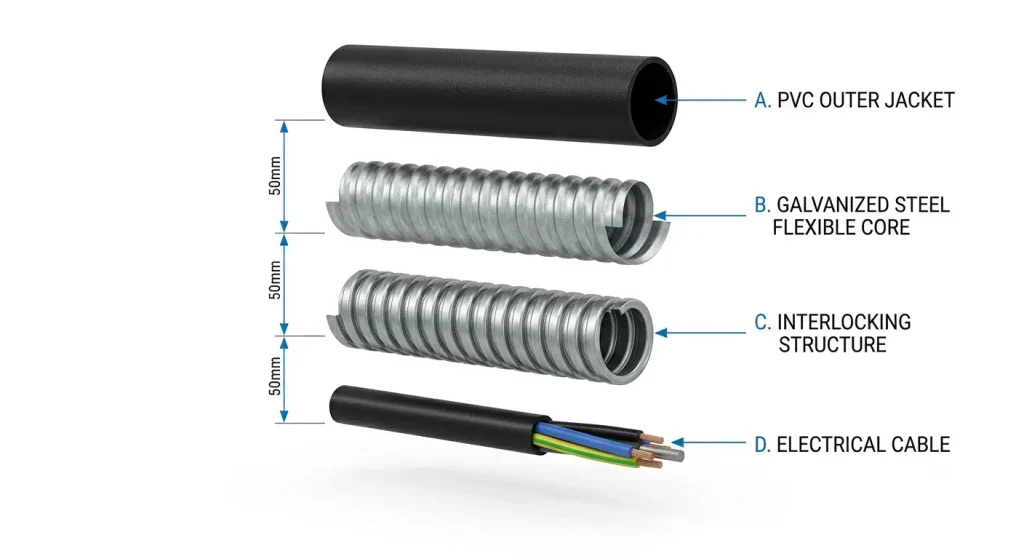
What is a GI PVC Coated Flexible Conduit?
A GI PVC Coated Flexible Conduit is a flexible cable protection system designed to safeguard electrical wiring in environments where cables and wires may be exposed to mechanical damage, moisture, dust, vibration, oils or harsh industrial conditions. It combines a galvanized steel flexible conduit with durable polyvinyl chloride coating (PVC), creating a conduit that gives both mechanical strength and environmental protection. The inner layer is manufactured from galvanized steel strips that are formed into a flexible interlocked conduit. This metallic core provides the structural strength needed to protect cables from crushing, impacts, and abrasion while allowing the conduit to bend around machinery, corners, and confined installation spaces without losing its shape. The galvanised steel core or the inner metal layer is specially coated with a PVC jacket. This outer layer has multiple purposes not just covering the metal. It protects the conduit from moisture, corrosion, oils, chemicals, UV exposure (depends on the PVC formulation) and everyday wear and tear. This smooth PVC surface also reduces the risk of any damage during and after the installation and provides an additional layer of electrical insulation. The combination of a galvanized steel core and PVC coating makes these conduits suitable for a wide range of industrial and commercial applications, including electrical control panels, machine tools, automation systems, HVAC equipment, packaging machinery, renewable energy installations, railway infrastructure, and manufacturing facilities. One of the biggest advantages of a GI PVC Coated Flexible Conduit is its ability to balance flexibility with protection. Unlike rigid conduits, it can be routed around complex machinery and tight spaces with ease, while still providing a durable protective barrier for the cables inside. However, the performance of the conduit depends not only on the PVC coating but also on the construction of its galvanized steel core. This is where the difference between Single Interlock and Double Interlock designs becomes important. 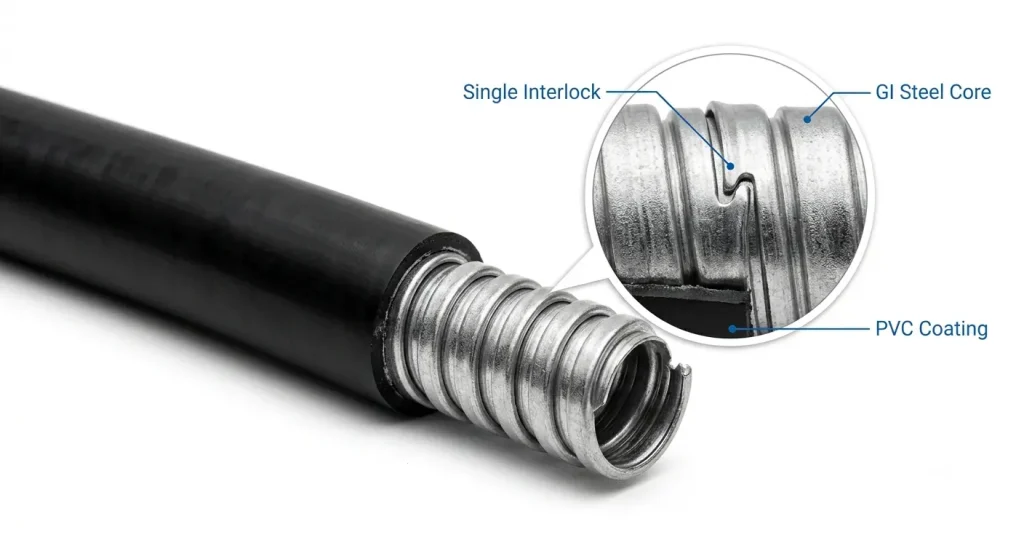
What is a Single Interlock GI PVC Coated Flexible Conduit?
A Single Interlock GI PVC Coated Flexible Conduit is a type of flexible electrical conduit in which the galvanized steel core is formed using a single interlocking seam before being covered with a protective PVC jacket. This design provides an excellent balance of flexibility, mechanical protection, and ease of installation, making it one of the most widely used conduit types for general industrial and commercial electrical uses. So, the galvanized steel strip is continuously shaped into a spiral conduit, with each turn mechanically interlocked once with the next. This single interlocking mechanism creates a flexible yet secure structure capable of protecting electrical cables from physical damage while still allowing the conduit to bend around obstacles and fit into compact installations spaces. After the galvanized inner core is manufactured, it is coated with a high-quality PVC layer that enhances resistance to moisture, dust, oils and corrosion. The PVC coating also helps extend the service life of the conduit in environments where the galvanized steel core may be exposed to challenging operating conditions. One of the key benefits of a Single Interlock GI PVC Coated Flexible Conduit is its flexibility. Because the galvanized steel core uses a single interlocking profile, the conduit can bend more easily than heavier-duty alternatives. This makes installation faster and removes the effort required to route cables and wire through machinery, control panels, ceilings, walls or other confined spaces. Single Interlock Conduits are commonly used in applications where moderate mechanical protection is sufficient and the conduit is not subjected to constant vibration, heavy pulling forces, or continuous movement. Typical applications include electrical control panels, commercial buildings, HVAC systems, indoor industrial machinery, automation equipment, lighting installations, and general-purpose cable management. For several electrical installations, a Single Interlock GI PVC Coated Flexible Conduit offers the ideal combination of performance, cost-effectiveness, and installation convenience. However, for applications involving higher mechanical stress or severe vibration, a stronger interlocking design may provide additional long-term reliability. 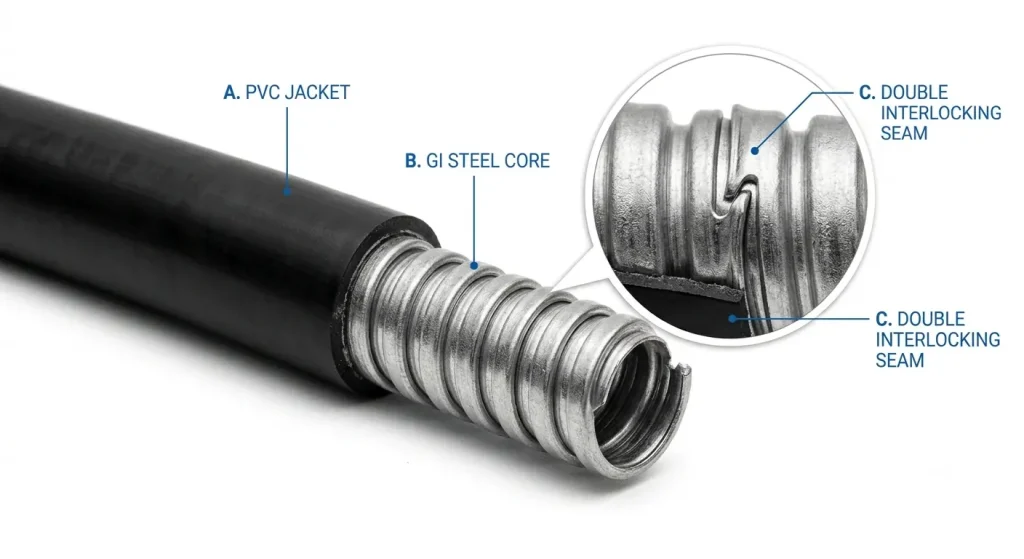
What is a Double Interlock GI PVC Coated Flexible Conduit?
A Double Interlock GI PVC Coated Flexible Conduit is a heavy-duty flexible designed for uses where electrical cables require a higher level of mechanical protection and long term usage without breaking down. Like the Single Interlock version, it consists of a galvanized steel flexible core covered with durable PVC outer jacket. The key difference lies in the way in the way the galvanized steel strip is interlocked during manufacturing. Instead of using a single locking seam, the galvanized steel strip is folded and mechanically interlocked twice, creating a stronger and more secure connection between each spiral turn. This reinforced construction increases the conduit’s ability to withstand pulling forces, continuous vibration, mechanical stress and demanding operation conditions. Once the steel core is formed, it is coated with flexible PVC jacket that provides an additional layer of protection against moisture, dust, oils, chemical and corrosion. The PVC coating also reduces surface wear and tear during installation and helps extend the conduit’s service life in harsh industrial environments. Due to its reinforced internal structure, a Double Interlock GI PVC Coated Flexible Conduit is commonly selected for heavy-duty machinery, Industrial automation systems, railway infrastructure, manufacturing plants, marine equipment, and mechanical strength often makes it the preferred choice for critical installations where equipment reliability is a priority. 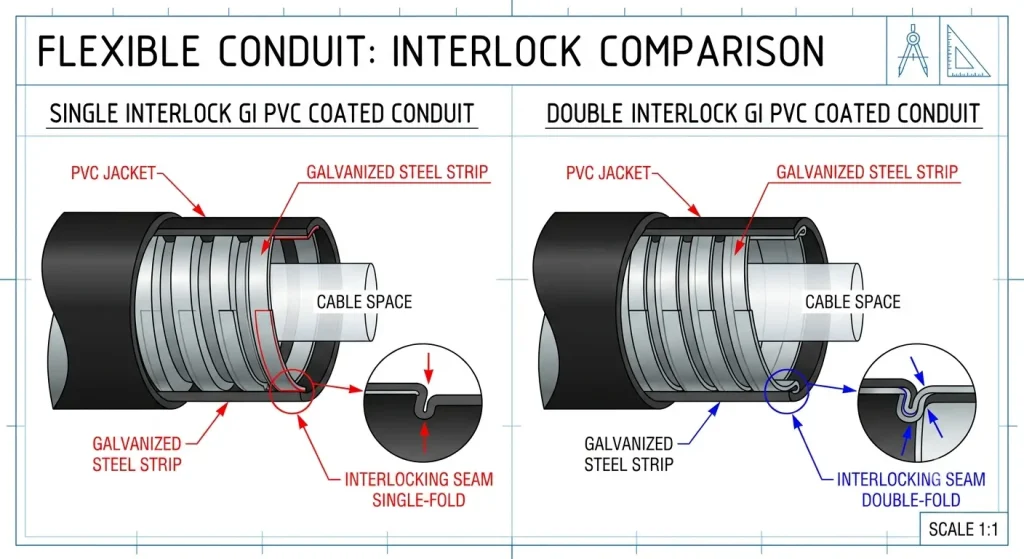
Construction of a GI PVC Coated Flexible Conduit
Although Single Interlock and Double Interlock conduits differ internally, both share the same basic construction. Each layer plays a specific role in protecting electrical cables and ensuring reliable performance.
1. PVC Outer Jacket
The Outermost layer is made from high-quality polyvinyl Chloride (PVC). This protective jacket acts as the first line of defense against environmental conditions. The PVC coating helps protect the conduit from:
- Moisture
- Dust
- Oils and lubricants
- Mild industrial chemicals
- Corrosion
- Abrasion
- Weather exposure
In addition to environmental protection, the smooth outer surface minimizes friction during installation, allowing the conduit to pass more easily through brackets, clamps and confined spaces.
2. Galvanized Steel Core
Beneath the PVC coating is the galvanized steel (GI) flexible conduit. Galvanization applies a protective zinc layer to the steel, helping prevent corrosion while maintaining the strength required for industrial cable protection. The galvanized steel core provides:
- Mechanical strength
- Flexibility
- Crush resistance
- Impact Protection
- Cable support
Without this steel core, the conduit would not be able to withstand the physical demands of industrial environments.
3. Interlocking Seam
The interlocking seam is the most important structural component of the conduit. It is created by continuously forming a galvanized steel strip into a spiral while mechanically locking each turn together. This interlocking structure allows the conduit to:
- Bend without separating
- Maintain its shape
- Protect cables during movement
- Absorb vibration
- Resist pulling forces
The number of interlocks determines how much mechanical strength the conduit can provide.
4. Internal Cable Space
The hollow interior of the conduit is designed to safely accommodate electrical cables while allowing enough flexibility for installation. A properly sized conduit should provide sufficient room for cable movement without compressing or damaging the insulation. Selecting the correct conduit diameter is just as important as selecting the correct conduit type. 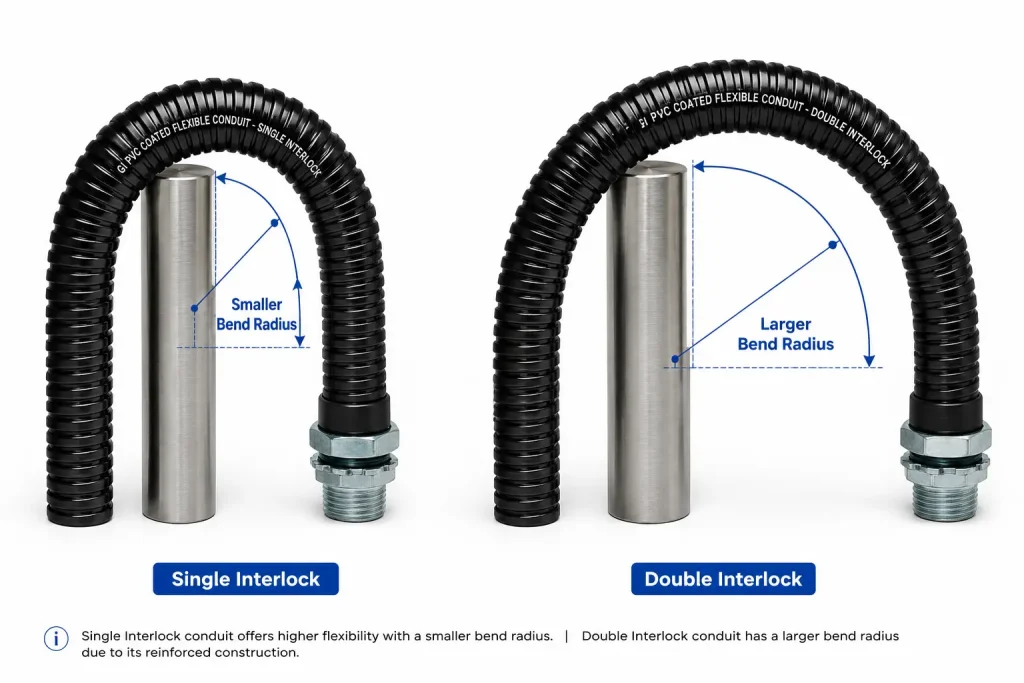
Single Interlock vs Double Interlock GI PVC Coated Flexible Conduit
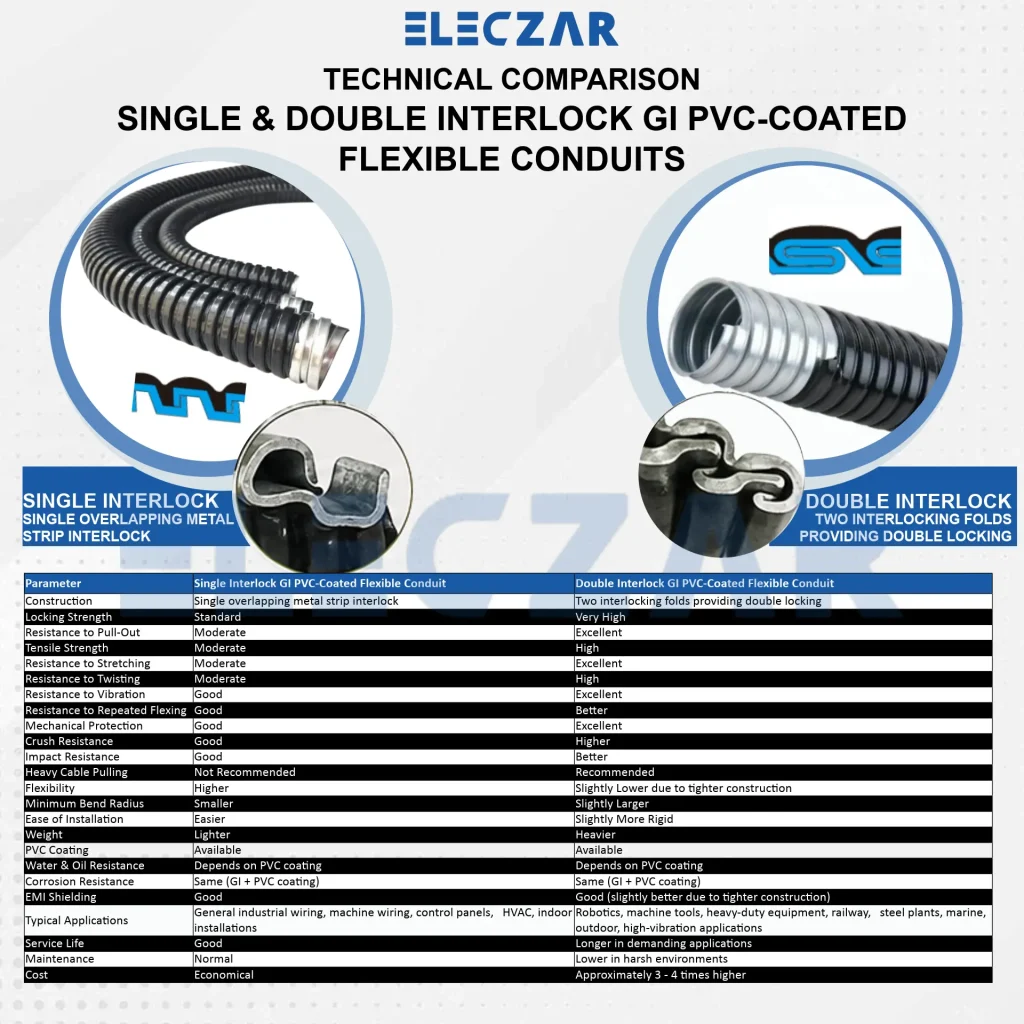
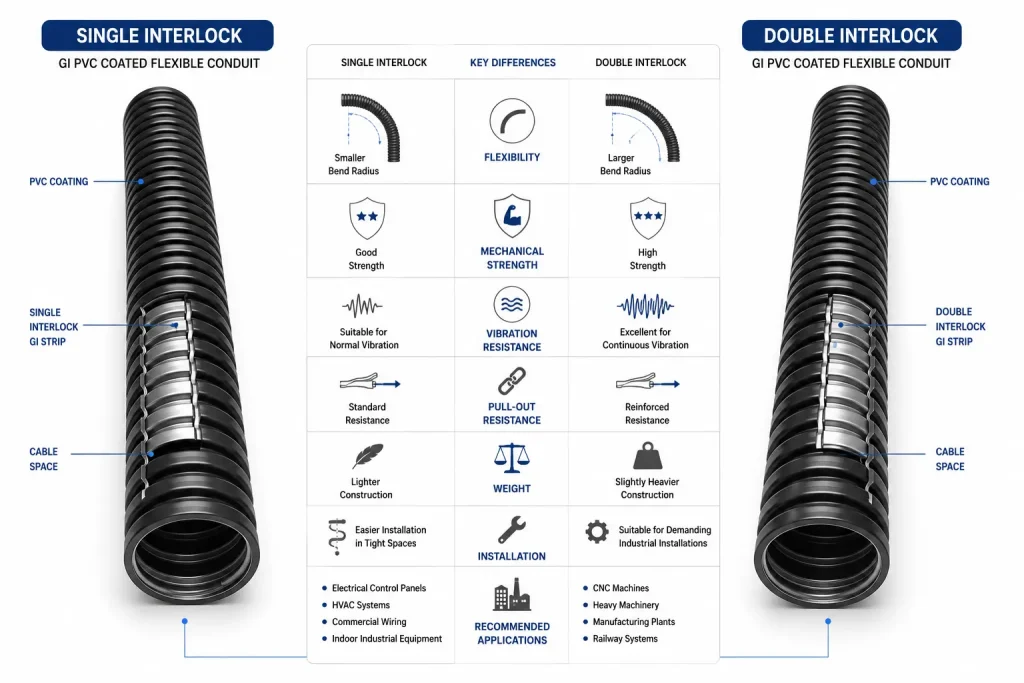
| Feature | Single Interlock | Double Interlock |
|---|---|---|
| Locking Mechanism | Single interlocking seam | Double interlocking seam |
| Mechanical Strength | Good | Excellent |
| Flexibility | Higher | Moderate |
| Pull-Out Resistance | Moderate | High |
| Vibration Resistance | Suitable for normal conditions | Excellent for continuous vibration |
| Crush Resistance | Good | Higher |
| Weight | Lighter | Slightly heavier |
| Installation | Easier in confined spaces | Slightly more rigid |
| Cost | More economical | Higher due to reinforced construction |
| Best For | General electrical installations | Heavy-duty industrial environments |
Understanding the key Differences
Mechanical Strength
The biggest difference between the two conduit types is their ability to withstand mechanical stress. A Double Interlock conduit distributes external forces across two locking points instead of one, resulting in a stronger overall structure. This makes it more suitable for environments where the conduit may experience impacts, heavy equipment movement, or repeated mechanical loading. Single Interlock conduits still provide dependable protection but are generally intended for applications with moderate mechanical demands.
Flexibility
Because the steel strip is secured using only one interlocking seam, a Single Interlock conduit bends more easily. This additional flexibility simplifies installation around tight corners, compact machinery, and crowded electrical panels. Double Interlock conduits remain flexible but require a slightly larger bending radius due to their reinforced construction.
Resistance to Vibration
Industrial machinery often generates continuous vibration during normal operation. Over time, vibration can place repeated stress on the conduit, gradually weakening less robust structure. The reinforced locking mechanism of a Double Interlock conduit helps maintain its structural integrity under these conditions, making it well suited for applications such as compressors, pumps, conveyor systems, CNC machines, and heavy manufacturing equipment. Single Interlock conduits perform well where vibration levels are relatively low or intermittent.
Pull-Out Strength
During installation or maintenance, conduits may occasionally be subjected to pulling forces. A stronger interlocking mechanism improves the conduit’s ability to resist separation when tension is applied. This characteristic becomes especially valuable in installations where cables and wires are routed over long distances or where machinery movement may create additional mechanical stress.
Installation
One advantage of Single Interlock conduits is their ease of installation. Their lighter construction allows installers to route the conduit more quickly through walls, ceilings, electrical cabinets, and machine frames. Double Interlock conduits may require slightly more efforts during installation, but the added durability often justifies the extra time in demanding environments. 
Advantages of Single Interlock GI PVC Coated Flexible Conduit
A Single Interlock GI PVC Coated Flexible is often the preferred choice for standard industrial and commercial electrical installations because it combines reliable cable protection with excellent flexibility and cost efficiency.
Some of its key advantages include:
Excellent Flexibility
The single interlocking construction allows the conduit to bend easily around obstacles, making installation faster and reducing the need for additional fittings.
Lightweight Design
Its lighter construction simplifies transportation, handling and installation, especially in overhead cables and wire routing and confined spaces.
Cost-Effective Solution
For applications that do not require heavy-duty mechanical protection, a Single Interlock conduit provides dependable performance while helping reduce project costs.
Reliable Cable Protection
The galvanized steel core protects cables from impacts and abrasion, while the PVC coating helps resist moisture, dust, oils and corrosion.
Suitable for General Industrial Applications
Single Interlock conduits perform well in electrical control panels, commercial buildings, machine wiring, HVAC systems, packaging equipment, and many indoor industrial environments.

Advantages of Double Interlock GI PVC Coated Flexible Conduit
A Double Interlock GI PVC Coated Flexible Conduit is designed for installations where electrical wiring is exposed to demanding operating conditions. Its reinforced interlocking galvanized steel core provides additional structural stability, making it suitable for applications where long-term durability is more important than maximum flexibility.
While a Single Interlock conduit performs well in many standard installations, the Double Interlock design offers additional mechanical strength that becomes valuable in environments with continuous vibration, frequent movement, or a higher risk of physical impact.
Superior Mechanical Strength
The double interlocking construction creates a stronger connection between each spiral of the galvanized steel strip. This reinforced structure helps the conduit maintain its shape under mechanical stress and provides greater protection for the electrical cables inside.
For machinery that operates continuously or is exposed to heavy-duty industrial use, this additional strength helps reduce the likelihood of conduit deformation over time.
Better Resistance to Continuous Vibration
Many industrial machines generates constant vibration during normal operation. Compressors, CNC machines, pumps, conveyor systems, and heavy manufacturing equipment all create repeated movement that can gradually weaken cable protection systems.
The reinforced construction of a Double Interlock conduit helps absorb these vibrations more efficiently, cable protection even when moderate tension is applied.
Longer Service Life in Demanding Environments
Industrial environments often expose conduits to vibration, mechanical contact, dust, moisture and continuous operation. The combination of a galvanized steel core, reinforced interlocking construction, and PVC outer coating allows Double Interlock conduits to maintain their performance for extended periods when installed correctly.
Suitable for Critical Industrial Installations
Where equipment reliability is essential and unexpected downtime can affect productivity, a Double Interlock conduit offers an added level of confidence by providing stronger mechanical protection for critical electrical wiring.
Industrial Applications
Choosing between a Single Interlock and Double Interlock GI PVC Coated Flexible Conduit Depends Largely on the conditions in which the conduit will operate. Although both products protect electrical cables, each is better suited for different types of installations.
Applications of Single Interlock GI PVC Coated Flexible Conduit
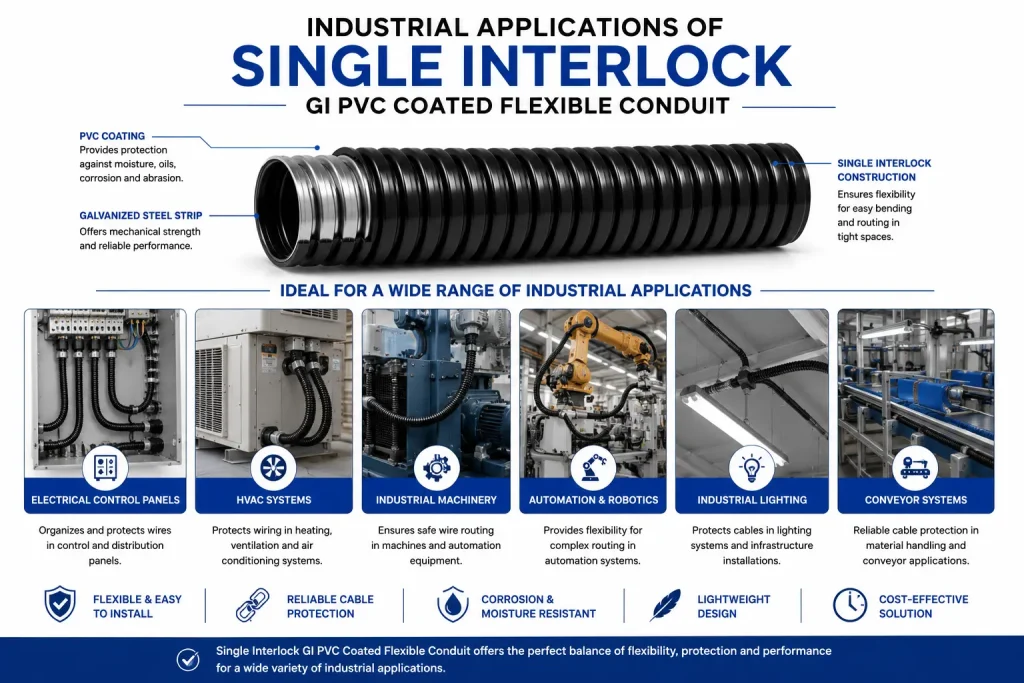
Because of its excellent flexibility and ease of installation, Single Interlock conduit is commonly used in applications where moderate mechanical protection is sufficient.
Electrical Control Panels
Electrical panels often contain multiple cables and wire routes within a limited amount of space. A Single Interlock conduit bends easily around components, allowing installers to create neat cable layouts while protecting wiring from accidental damage.
Commercial Buildings
Commercial electrical installations typically require conduits that are easy to install while giving reliable cable and wire protection. Single Interlock conduits are frequently used for indoor wiring where environmental conditions are relatively stable.
HVAC Systems
Heating, ventilation, and air-conditioning equipment contains electrical wiring that must remain protected from dust, moisture, and routine servicing. Flexible conduits simplify cable routing around equipment with limited installation space.
General Industrial Machinery
Machines that operate under normal conditions without excessive vibration often benefits from the flexibility and cost-effectiveness of Single Interlock conduits.
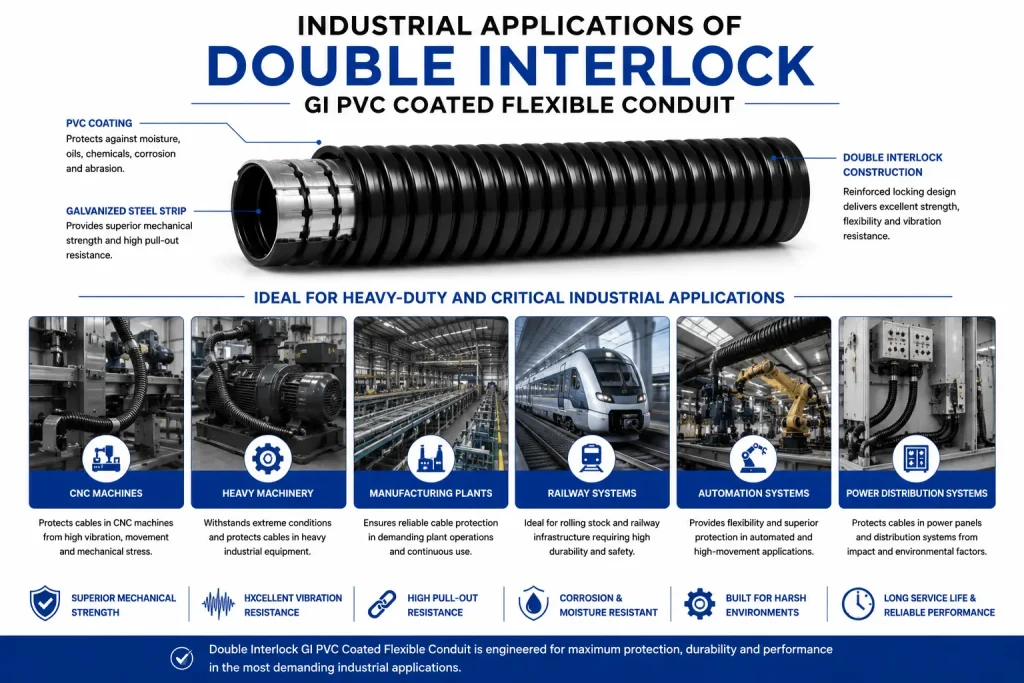
Applications of Double Interlock GI PVC Coated Flexible Conduit
Double Interlock conduits are intended for environments where cables experience greater mechanical stress or continuous movement.
CNC Machines
CNC equipment often operates around the clock. Double Interlock conduits provide reliable cable protection in areas where equipment is subjected to repeated mechanical stress.
Conveyor Systems
Conveyor expose electrical wiring to constant movement and vibration. The stronger interlocking construction helps improve long-term durability in these applications.
Railway Infrastructure
Railway systems experience frequent vibration caused by moving equipment. Double Interlock conduits provide additional protection for electrical wiring installed in these demanding environments.
Petrochemical and Process Industries
Industrial facilities often require robust cable and wire protection capable of resist harsh operating conditions. The galvanized steel core and PVC outer coating help protect electrical wiring from mechanical damage while resisting exposure to moisture and industrial contaminants.
Outdoor Industrial Equipment
When combined with suitable fittings and installed correctly, GI PVC Coated Flexible Conduits can be used to protect electrical cables and wires in outdoor industrial applications where environmental exposure is a consideration.
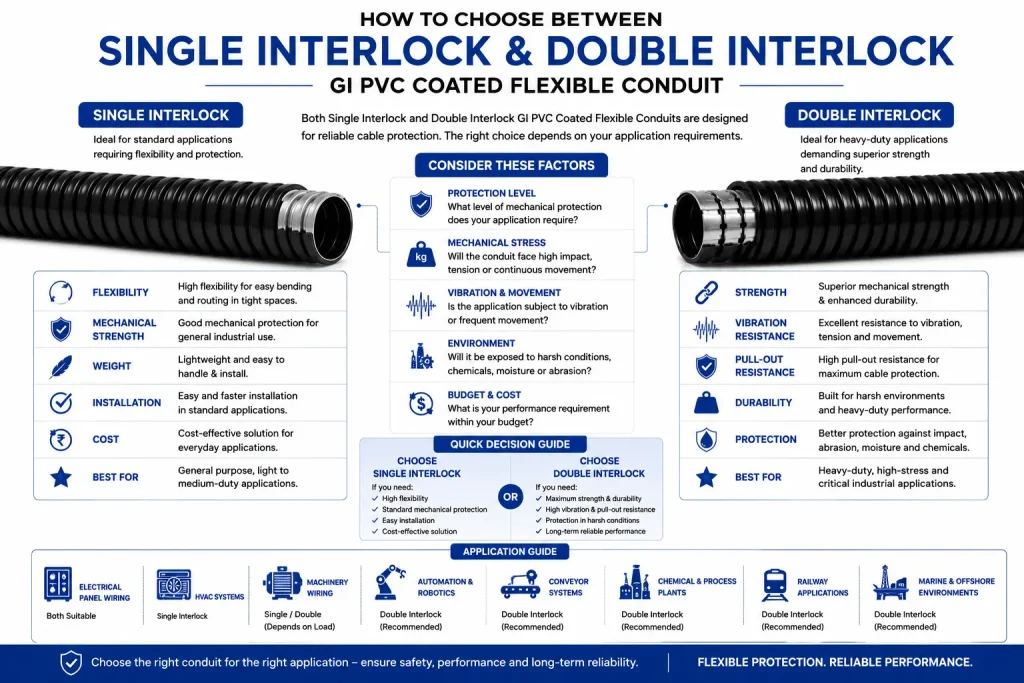
How to Choose Between Single Interlock and Double Interlock GI PVC Coated Flexible Conduit
There is no universal answer to which conduit is “better.” The right choice depends on the environment, the equipment being protected, and the level of mechanical protection required.
Before selecting a conduit, consider the following factors.
Installation Environment
Will the conduit be installed indoors, outdoors, or in an industrial production area?
Outdoor and heavy industrial environments often require greater protection that indoor commercial installations.
Vibration Levels
Equipment such as pumps, compressors, CNC machines, and production machinery generate continuous vibration.
Where vibration is expected, a Double Interlock conduit generally provides better long-term performance.
Mechanical Stress
Consider whether the conduit may be exposed to accidental impacts, pulling forces, or moving machine components.
Applications with greater mechanical stress generally benefits from the reinforced construction of a Double Interlock conduit.
Flexibility Requirements
If the installation involves numerous bends or confined spaces, the additional flexibility of a Single Interlock conduit may simplify installation.
Budget
Single Interlock conduits typically offer a more economical solution for standard electrical installations.
Double Interlock conduits involves a higher initial investment but may reduce maintenance and replacement costs in demanding environments.
Future Maintenance
Think about how accessible the conduit will be after installation.
Choosing a conduit with the appropriate level of durability can help minimize future maintenance requirements and improve long-term system reliability.
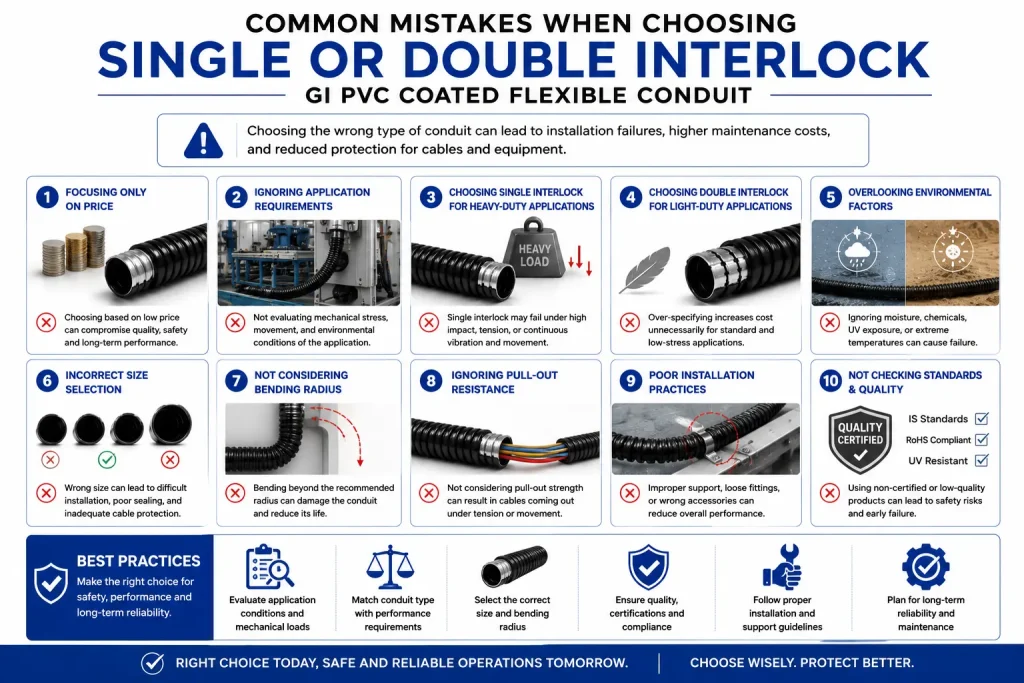
Common Mistakes When Selecting a Flexible Conduit
Even a high-quality conduit may not perform as expected if it is chosen without considering the application’s operating conditions.
Some common selection mistakes include:
Selecting only on Price
Lower initial cost does not always result in the lowest lifetime cost. Choosing a conduit that cannot withstand the operating environment may lead to more frequent replacements and maintenance.
Ignoring Vibration
Installing a conduit intended for light-duty applications on continuously vibrating equipment can reduce its service life and increase maintenance requirements.
Choosing the wrong diameter
A conduit should provide enough internal space for cables without excessive compression. Overfilled conduits can make installation difficult and reduce protection.
Using the Wrong Fittings
Compatible conduit fittings are essential for maintaining secure connections and protecting cables throughout the installation.
Overengineering the installation
Not every application requires a Double Interlock conduit. Installing a heavy-duty conduit where standard protection is sufficient can unnecessarily increase project costs.

Installation Best Practices
Proper installation plays an important role in maximizing the performance and service life of any GI PVC Coated Flexible Conduit.
Some recommended practices include:
- Select the correct conduit diameter based on cable size and quantity.
- Avoid bending the conduit beyond its recommended bend radius.
- Use compatible conduit fittings designed for the conduit type.
- Secure the conduit at appropriate interval using suitable clamps or supports.
- Avoid twisting the conduit during installation.
- Inspect the conduit for damage before and after installation.
- Ensure cables can move freely inside the conduit without excessive compression.
Following these practices help maintain cable and wire protection and improves the overall reliability of the electrical installation.
Frequently Asked Questions
What is a Single Interlock GI PVC Coated Flexible Conduit?
Its is a flexible conduit with a galvanized steel core constructed using single interlocking seam and protected by a PVC outer coating. It provides reliable cable protection for many commercial and industrial electrical installations.
What is a Double Interlock GI PVC Coated Flexible Conduit?
It uses a galvanized steel core with two interlocking seams, offering greater mechanical strength and improved resistance to vibration and demanding operating conditions.
Which conduit is stronger?
A Single Interlock conduit is typically more flexible, making it easier to install in confined spaces or around multiple bends.
Is Double Interlock always the better choice?
Not necessarily. If your installation does not involve heavy vibration or mechanical stress, a Single Interlock conduit may provide all the protecting required while offering easier installation and lower cost.
Can GI PVC Coated Flexible Conduits be used outdoors?
Yes. When installed with appropriate weather-resistant fittings and selected for the intended environment, they can be used in many outdoor industrial and commercial applications.
What does the PVC coating do?
The PVC jacket helps protect the galvanized steel core from moisture, dust, oils, mild chemicals, abrasion, and corrosion while also providing and additional layer of insulation.
Why is galvanized steel used inside the conduit?
Galvanized steel provides the mechanical strength needed to protect electrical cables while maintaining the flexibility required for routing around machinery and equipment.
Which industries commonly use these conduits?
Galvanized steel provides the mechanical strength needed to protect electrical cables while maintaining the flexibility required for routing around machinery and equipment.
Which industries commonly use these conduits?
They are widely used in manufacturing, automation, electrical control panels, HVAC systems, packaging equipment, railway infrastructure, renewable energy installations, and commercial electrical projects.
How do I choose the correct conduit size?
The conduit should be selected based on the number, diameter, and routing needs of the cables while allowing adequate space for installation and future maintenance
Conclusion
Both Single Interlock and Double Interlock GI PVC Coated Flexible Conduits are designed to protect electrical cables, but they are intended for different operating conditions.
A Single Interlock GI PVC Coated Flexible Conduit offers an excellent balance of flexibility, ease of installation, and cost-effectiveness, making it suitable for general industrial, commercial, and electrical applications where moderate mechanical protection is sufficient.
A Double Interlock GI PVC Coated Flexible Conduit is designed for installations where cables are exposed to continuous vibration, greater mechanical stress, or demanding industrial environments. Its reinforced galvanised steel core provides enhanced durability and long-term reliability for critical applications.
By evaluating factors such as vibration levels, installation conditions, mechanical stress, flexibility requirements, and long-term maintenance needs, you can choose the conduit that best matches your project and helps ensure dependable cable protection throughout the life of the installation.