
Introduction
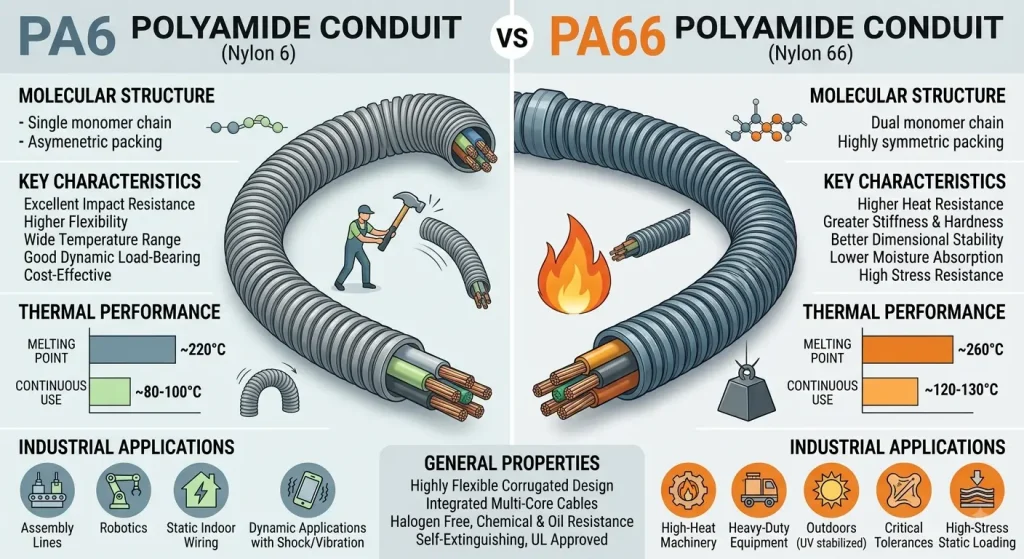
For a normie (or a normal person), two polyamide conduits may appear almost identical. They can have the same size, similar corrugated design, identical fittings, and even perform the same basic function of protecting electrical cables and wires. However, beneath that similar appearance lies one of the most important factors affecting conduit performance-the material grade.
Picking between PA6 (Polyamide 6) and PA66 (Polyamide 66) is not simply about selecting one type of nylon over the another. It is very important decision that directly affects the conduit’s flexibility, mechanical strength, temperature resistance, wear characteristics, moisture absorption, service life, and long-term reliability.
In an Industrial scenario, electrical conduits are constantly exposed to demanding operating conditions. They many experience continuous vibration from heavy machinery, elevated temperatures inside electrical enclosures, repeated bending in robotic automation systems, exposure to oils and chemicals on factory floors, or harsh outdoor weather conditions. A conduit that performs exceptionally well in one environment may not be the best choice in another.
This is exactly why engineers, panel builders, machine manufacturers, OEMs, and maintenance professionals often pay close attention to the material used in conduit manufacturing rather than considering only its dimensions or accessories.
Among engineering thermoplastics, Polyamide 6 (PA6) and Polyamide 66 (PA66) are the two most commonly used materials for flexible conduits. Both belong to the nylon family and are trusted across industries because of their excellent mechanical properties, abrasion resistance, and electrical insulation. Yet, despite their similarities, they totally differ in several key areas that can significantly impact the performance and lifespan of an electrical wiring system.
Understanding these differences helps engineers to select the right conduit for each application instead of relying on assumptions or choosing solely based on price which can be a blunder. In many cases selecting the appropriate material can reduce maintenance costs, improve cable protection, increase system reliability, and extend the overall service life of industrial equipment.
In this guide, we’ll compare PA6 and PA66 conduits in detail, examine their physical and mechanical characteristics, discuss their advantages and limitations, explore where each material performs best, and help you take decision which option is better suited for your industrial wiring applications.
What Are Polyamide Conduits?
Polyamide Conduits are flexible cable and wire protection systems manufactured using high-performance engineering plastics from the nylon family. They are designed to organize, route, and protect electrical cables against mechanical damage, abrasion, dust, moisture, vibration, chemicals, and environmental exposure.
Unlike conventional PVC conduits, polyamide conduits are specially engineered for demanding industrial applications where durability, flexibility, and long service life are essential. Their corrugated construction allows them to bend around machinery, equipment frames, cable trays, and trapped installation spaces while maintaining structural integrity and protecting the cables inside.
Today, polyamide conduits are widely used across industries including:
- Industrial automation
- Control panel manufacturing
- Robotics
- CNC machines
- Railway systems
- Renewable energy installations
- Automotive manufacturing
- Packaging machinery
- HVAC systems
- Food processing equipment
- Marine electrical systems
- Heavy engineering plants
Their popularity comes from the ability to combine flexibility with excellent mechanical protection – Something that rigid conduits cannot always provide.
Why Are Polyamide Conduits Preferred Over Conventional Plastic Conduits?
Industrial electrical installations operate under conditions that ordinary plastic conduits often struggle to withstand. Machinery vibrates continuously, moving equipment bends cable routes repeatedly, electrical cabinets generate heat, and manufacturing environments expose wiring systems to dust, oils, and chemicals.
Polyamide conduits are specifically designed to address these challenges.
Some of their key advantages also include:
Excellent Mechanical Strength
Despite being lightweight, polyamide conduits offer impressive resistance and compressive strength. They protect cables from accidental impacts, crushing forces, and external mechanical damage that could otherwise lead to costly downtime.
High Flexibility
The corrugated design allows the conduit to bend around tight installation spaces without collapsing. This flexibility simplifies installation while reducing stress on electrical cables.
Superior Abrasion Resistance
Industrial cables often move inside machinery or experience continuous vibration. Polyamide materials provide excellent wear and resistance, reducing the risk of conduit deterioration over time.
Lightweight Construction
Compared to metallic conduit systems, polyamide conduits are significantly lighter, making transportation, storage, and installation easier while reducing structural loading.
Electrical Insulation
Polyamide is naturally non-conductive, making it suitable for protecting electrical wiring while reducing the risk of accidental electrical contact.
Corrosion Resistance
Unlike metallic conduits that may corrode in humid or chemically aggressive environments, polyamide conduits resist moisture and many industrial chemicals, making them suitable for both indoor and outdoor applications.
Long Service Life
When correctly selected for the application, polyamide conduits can provide years of reliable cable protection with minimal maintenance requirements.
Where Are Polyamide Conduits Used?
Polyamide conduits are found almost everywhere modern industrial automation exists.
For example, in a CNC machining center, multiple servo motors, sensors, and control cables move continuously throughout the day. Flexible conduits protect these cables while accommodating constant machine movement.
Inside every electrical control panels, conduits organize wiring, prevent cable abrasion against metal edges, and simplify maintenance.
In robotic production lines, conduit flexibility becomes even more important because robotics arms repeatedly bend and twist cable assemblies thousands of times each day.
Similarly, railway systems rely on durable conduits capable of resisting vibration, temperature fluctuations, dust, and moisture over many years of operation.
As industries continue adopting automation and smart manufacturing, demand for high-performance polyamide conduit systems continues to grow because they combine flexibility with reliable cable and wire protection.
Understanding PA6 and PA66 Materials
Although PA6 and PA66 are both members of the polyamide family, they are not nearly identical materials. Their molecular structure differs, leading to noticeable difference in stiffness, flexibility, thermal stability, wear resistance, moisture absorption, and overall mechanical performance.
Understanding these material characteristics is essential because the conduit’s performance depends not only on its design but also on the engineering polymer used during manufacturing.
What is PA6 (Polyamide 6)?
PA6, commonly known as polyamide 6 or Nylon 6, is one of the most widely used engineering thermoplastics in industrial manufacturing.
It is valued for its excellent balance of:
- Flexibility
- Impact resistance
- Toughness
- Abrasion resistance
- Ease of processing
- Cost-effectiveness
These characteristics make PA6 an ideal material for flexible conduit systems that require frequent bending or installation in confined spaces.
One of PA6’s greatest strengths is its ability to absorb impact without becoming brittle. Even under repeated movement or vibration, PA6 maintains excellent durability while remaining easier to install than many stiffer engineering plastics.
Because of this balance between flexibility and strength, PA6 conduits are commonly used in:
- Industrial automation
- Control panels
- Packaging
- machinery
- Machine tools
- HVAC systems
- Commercial electrical installations
- General manufacturing equipment
For most standard industrial environments, PA6 offers more than enough performance while remaining economical.
What Is PA66 (Polyamide 66)?
PA66, also known as Polyamide 66 or Nylon 66, is considered a higher-performance engineering plastic compared to PA6 in applications involving elevated temperatures and greater mechanical loads.
Its molecular structure creates stronger intermolecular bonding, resulting in improved:
- Tensile strength
- Surface hardness
- Rigidity
- Heat resistance
- Wear resistance
- Dimensional stability
Because of these properties, PA66 conduits are often selected for heavy-duty industrial applications where the conduit must withstand demanding operating conditions over long service periods.
Examples include:
- Heavy industrial machinery
- Steel plants
- Mining equipment
- Railway infrastructure
- Automotive manufacturing
- Industrial robotics
- Power generation facilities
- High-temperature electrical installations
Although PA66 generally provides superior strength and thermal performance, it is also slightly stiffer than PA6. In installations requiring frequent bending around tight corners, engineers may still prefer PA6 because its flexibility simplifies routing and installation.
Why Does the Material Grade Matter?
Many buyers assume that if two conduits have the same dimensions and fittings, they will perform identically. In reality, the material grade often determines how well the conduit performs over years of service.
For example:
- A conduit installed inside a standard electrical control panel may never experience extreme temperatures or heavy mechanical loads. In this case, PA6 often provides the right balance of performance and cost.
- A conduit installed on heavy industrial machinery may be exposed to constant vibration, elevated temperatures, and repetitive mechanical stress. Under these conditions, PA66’s higher stiffness and thermal stability can make it a more suitable choice.
Material selection also affects installation, maintenance intervals, replacements frequency, and the overall reliability of an electrical system.
Instead of asking, “Which material is better?”, engineers should ask, “Which material is better for this specific operating environment?”
That question forms the basis of every successful conduit selection – and it’s the comparison we’ll explore in the next section, where we’ll examine PA6 and PA66 side by side across key performance characteristics such as mechanical strength, flexibility, temperature resistance, moisture absorption, wear resistance, and long term durability.
PA6 vs PA66 Conduits: Side-by-Side Comparison
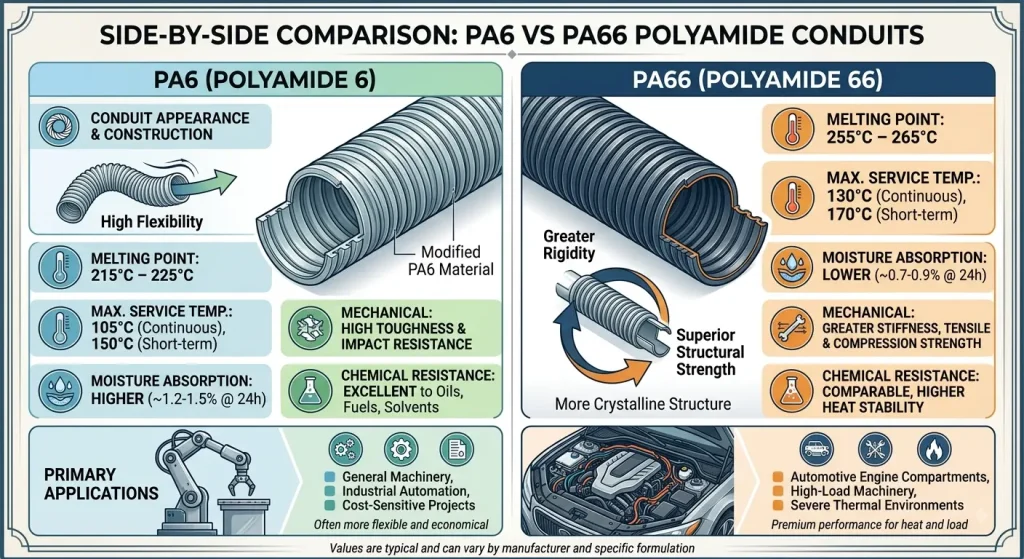
Usually both PA6 and PA66 are of the polyamide family, but they are made to meet different performance requirements. Their chemical structure may be similar, but subtle differences at the molecular level result in noticeable variations in strength, flexibility, thermal stability, moisture absorption, wear resistance, and long-term durability.
This indicates that two conduits with identical dimensions may behave very differently once installed in a real industrial environment. A conduit that is used on a moving robotics arm has different demands that one protecting cables inside a static control panel. similarly, equipment operating in high-temperature manufacturing plants place greater stress on conduit materials than installations in climate-controlled facilities.
Instead of asking which material is universally “better”, the more practical question would be which material is better suited for your application’s operating conditions.
The following comparison highlights the major differences between PA6 and PA66 conduits.
| Property | PA6 Conduit | PA66 Conduit |
|---|---|---|
| Flexibility | Excellent | Very Good |
| Mechanical Strength | Excellent | Superior |
| Heat Resistance | Very Good | Excellent |
| Wear Resistance | Excellent | Superior |
| Moisture Absorption | Higher | Lower |
| Dimensional Stability | Good | Excellent |
| Surface Hardness | Good | Higher |
| Chemical Resistance | Excellent | Excellent |
| Installation | Easier | Slightly More Rigid |
| Cost | More Economical | Premium Performance |
While this table provides a quick overview, each property influences the conduit differently depending on where it will be installed.
Mechanical Properties Comparison
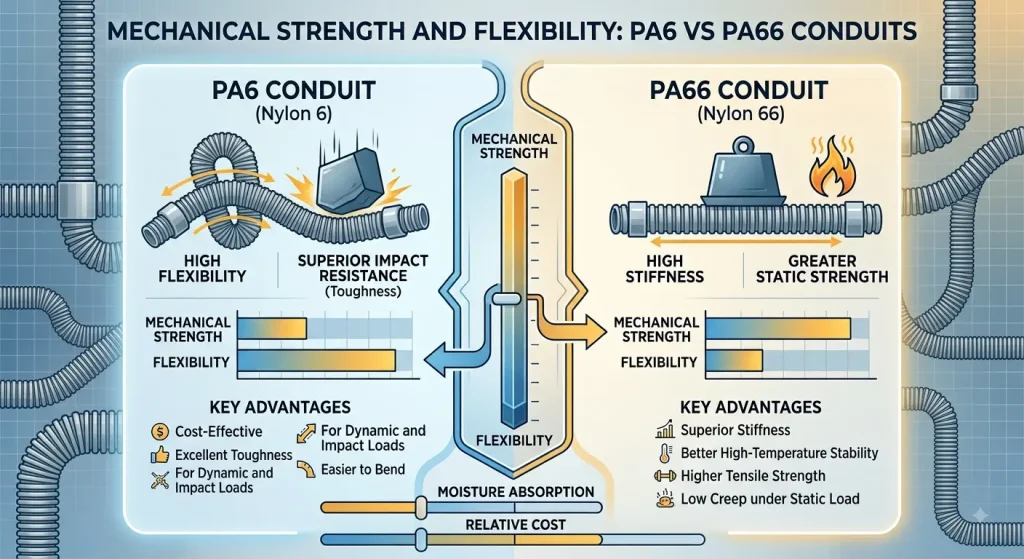
Mechanical performance is one of the most important considerations when selecting a flexible conduit. Industrial wiring systems rarely remain untouched throughout their service life. They are subjected to pulling forces during installation, vibration from operating machinery, accidental impacts during maintenance, and continuous movement is automated equipment.
The conduit with insufficient mechanical strength may deform, crack, or wear prematurely, leaving electrical cables exposed to damage.
This is why understanding the mechanical differences between PA6 and PA66 is essential.
Mechanical Strenght
Both PA6 and PA66 offer significantly higher mechanical strength than many standard engineering plastics, making them excellent choices for industrial cable protection.
However, PA66 has a higher tensile strength and greater rigidity due to its more crystalline molecular structure. This enables it to withstand heavier mechanical loads while maintaining its shape over long periods.
In practical terms, this means PA66 conduits are better suited for applications involving:
- Heavy industrial machinery
- High cable loads
- Continuous mechanical stress
- Manufacturing equipment
- Industrial automation
- systems operating around the clock
PA6, while slightly less rigid, still provides excellent structural integrity for the vast majority of industrial installations. It is capable of protecting cables against everyday mechanical impacts while offering greater flexibility during installation.
For most control panels, factory equipment, commercial electrical systems, and automation machinery, PA6 provides more than sufficient mechanical performance.
Impact Resistance
Impact resistance refers to the material’s ability to absorb sudden mechanical shocks without cracking or breaking.
Industrial environments are unpredictable. Maintenance tools may accidently strike conduit systems, machinery components can vibrate against cable routes, or moving equipment may place temporary loads on conduit assemblies.
PA6 performs exceptionally well under impact loading because of it’s natural toughness.
Its slightly lower stiffness allows it to absorb impact energy more efficiently instead of transferring the entire force into the material.
This makes PA6 particularly suitable for installations where accidental impacts are more common.
PA66 also offers excellent impact resistance but achieves it through a different balance of strength and rigidity. Rather than flexing as much as PA6, it resists deformation more strongly.
For heavy industrial applications where structural integrity is the primary concern, PA66 remains an excellent choice,
Surface Hardness
Surface hardness influences how well a conduit resists scratches, abrasion, and gradual wear over time.
As cables move inside the conduit or as the conduit rubs against surrounding machinery, the outer surface experiences continuous friction.
PA66 generally exhibits higher surface hardness than PA6.
This results in:
- Better scratch resistance
- Reduced surface wear
- Improved appearance over long service periods
- Better dimensional retention under repeated friction
PA6 still provides outstanding abrasion resistance but may show cosmetic wear slightly sooner in extremely demanding environments.
Abrasion Resistance
Abrasion is one of the most common causes of conduit deterioration in industrial installations.
Repeated movement causes cable bundles and conduit walls to experience continuous friction.
Examples include:
- Robotics cable carriers
- Conveyor systems
- Packaging machines
- CNC machining centers
- Automated production lines
Both PA6 and PA66 perform exceptionally well compared to conventional plastic conduit materials.
However, PA66’s harder surface provides a slight advantage in installations involving constant rubbing or repetitive movement.
This additional wear resistance can extend conduit life in demanding industrial environments.
Fatigue Resistance
Fatigue resistance measures a material’s ability to withstand repeated bending, vibration, and cyclic loading without developing cracks.
Unlike a single heavy impact, fatigue damage develops gradually over thousands-or even millions-of movement cycles.
This property becomes especially important in:
Robotic arms
Moving machinery
Cables drag chains
Automated production systems
Servo motor assemblies
PA6 performs extremely well because its flexibility allows it to bend repeatedly without concentrating excessive stress at one point.
Its ability to absorb movement makes it particularly suitable for dynamic cable protection.
PA66 also performs well under cyclic loading but favours applications where structural rigidity is more importamt that repeatedly flexing.
Dimensional Stability
Dimensional stability describes how well a material maintains its original shape when exposed to mechanical loads, temperature changes, or environmental conditions.
This characteristics becomes increasingly important in precision machinery.
If a conduit expands, contracts, or deforms excessively, it can:
- Place stress on conduit fittings
- Reduce sealing performance
- Affect cable routing
- Increase maintenance requirements
PA66 generally demonstrates superior dimensional stability.
It’s higher stiffness allows it to retain its shape more effectively over extended periods.
For machinery requiring tight manufacturing tolerances, PA66 often provides better long-term consistency.
PA6 also offers good dimensional stability but may experience slightly greater dimensional changes under demanding operating conditions.
Long-Term Durability
Mechanical strength alone does not determine how long a conduit will last.
- Temperature
- Humidity
- Mechanical stress
- UV exposure
- Chemicals
- Continuous vibration
- Repeated movement
Both PA6 and PA66 are designed for industrial service, but they excel under different conditions.
PA6 is widely recognized for providing an excellent balance between toughness, flexibility, and cost-effectiveness, making it ideal for general industrial installations.
PA66, on the other hand, is often selected where long-term mechanical reliability under demanding operating conditions is the highest priority.
It’s superior stiffness, hardness, and resistance to deformation help maintain performance over extended service periods.
Which Material Offers Better Mechanical Performance?
The answer depends on the application rather than the specification sheet.
Choose PA6 when your application requires:
- High flexibility
- Frequent bending
- Dynamic cable movement
- Easier installation
- Cost-effective industrial wiring
- General automation systems
Choose PA66 when your application requires:
- Higher structural strength
- Greater rigidity
- Better wear resistance
- Heavy industrial machinery
- High mechanical loading
Neither material replaces the other. Instead, each has been developed to perform optimally under different operating conditions.
In the next section, we’ll compare how PA6 and PA66 perform under high temperatures, continuous heat exposure, moisture, chemicals, and harsh industrial environments, helping you understand why thermal performance is often the deciding factors in material selection.
Temperature Performance: PA6 vs PA66
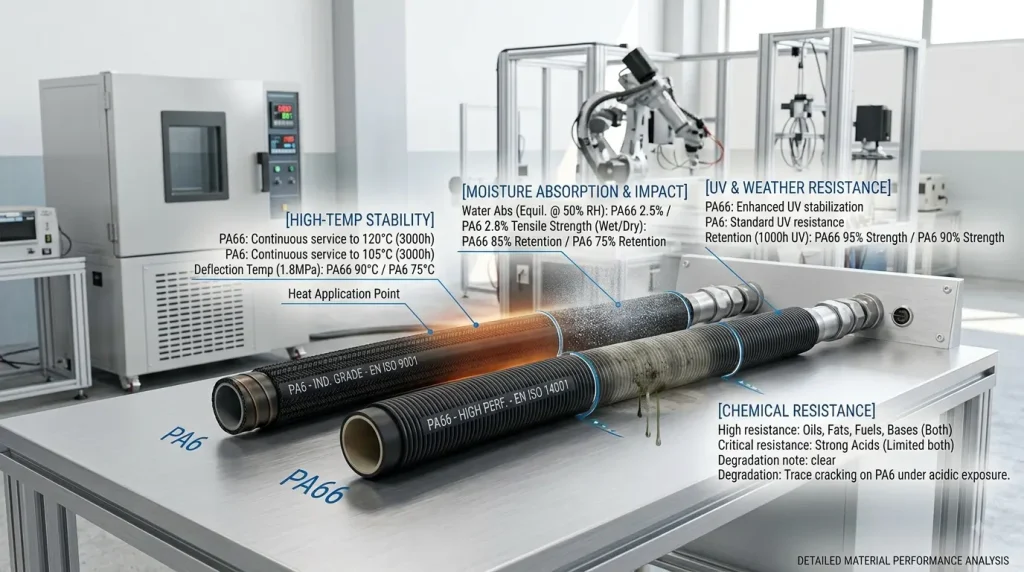
Temperature is one of the most important factors that are considered when selecting a polyamide conduit. A conduit may perform perfectly under normal indoor conditions but behave differently when continuously exposed to elevated temperatures.
Industrial equipment can generate significant heat around motors, electrical cabinets, control panels, furnaces, engines, and production machinery. The conduit material must therefore retain its mechanical properties and dimensional stability throughout the expected operating temperature range.
PA6 and PA66 can both handle demanding industrial environments, but PA66 generally provides better thermal stability.
PA6 Temperature Performance
PA6 offers good resistance to high temperatures and is suitable for a wide range of general industrial applications.
Its combination of toughness and flexibility makes it particularly useful where the conduit is exposed to moderate and fluctuating temperatures rather than continuous extreme heat.
Typical applications include:
- Electrical control panels
- Automation equipment
- Machine tools
- HVAC equipment
- Packaging machinery
- General industrial wiring
- Factory automation systems
PA6 is often the practical choice when the installation requires a balance between flexibility.
However, prolonged exposure to temperatures near the upper operating limit can gradually affect its mechanical properties. This is particularly important when the conduit is continuously exposed to heat rather than experiencing occasional temperature peaks.
PA66 Temperature Performance
PA66 generally performs better than PA6 at elevated temperatures.
Its higher melting point, greater rigidity, and improved thermal stability allow it to retain mechanical properties more effectively when exposed to prolonged heat.
This makes PA66 particularly attractive for applications involving:
- High-temperature machinery
- Automotive manufacturing equipment
- Engine compartments
- Industrial ovens
- Power-generation equipment
- Heavy machinery
- High-temperature electrical installations
For applications where the conduit is positioned close to heat-generating equipment, selecting a material with stronger thermal stability can significantly improve long-term reliability.
It is important to remember, but the actual temperature rating of a finished conduit depends on the specific compound, additives, construction, wall thickness, manufacturing process, and applicable product standard. Engineers should always check the manufacturer’s technical data rather than selecting a conduit based solely on the general properties of PA6 or PA66.
Moisture Absorption and Environmental Exposure
Moisture absorption is another important difference between PA6 and PA66.
Polyamides naturally absorb some moisture from their surrounding environment. Water molecules can interact with the polymer structure, which can influence properties such as dimensional stability, stiffness, and electrical characteristics.
PA6 generally absorbs more moisture than PA66.
This does not mean the PA6 is unsuitable for humid environments. Properly designed PA6 conduit systems can be used successfully in many industrial environments. However, when dimensional stability and consistent mechanical performance are particularly important, PA66 can offer an advantage.
Moisture exposure should therefore be considered alongside temperature, mechanical loading, and the conduit construction itself.
- UV resistance
- IP protection provided by the complete conduit and fitting system
- Sealing performance
- Chemical exposure
- Temperature cycling
- Installation method
The material grade is only one part of the overall environmental protection system.
Chemical Resistance
Industrial wiring is frequently exposed to substances that would damage ordinary plastics.
Depending on the industry, conduit systems may encounter:
- Cutting oils
- Lubricants
- Greases
- Cleaning agents
- Fuels
- Hydraulic fluids
- Industrial chemicals
- Coolants
- Solvents
Both PA6 and PA66 offer good resistance to many common industrial chemicals, but their actual resistance depends heavily on the specific chemical, concentration, temperature, exposure duration, and environmental conditions.
This is particularly important because chemical resistance can change at elevated temperatures. A material that performs well against a chemical at room temperature may behave differently when the same chemical is present at a significantly higher temperature.
For this reason, chemical compatibility should be verified against the actual substance involved rather than relying on a general statement such as “polyamide is chemical resistant.”
For applications involving aggressive chemicals, manufacturers should provide compatibility information or test data whenever possible.
Flexibility and Installation
One of the biggest Practical differences between PA6 and PA66 is flexibility.
PA6 generally offers greater flexibility, making it easier to route around corners, through confined spaces, and around moving components.
This can make a significant difference during installation.
- A flexible conduit can:
- Follow complex cable routes
- Reduce installation effort
- Accommodate movement
- Simplify cable management
- Reduce excessive stress on cables
- Make maintenance easier
This particularly useful in control panels, machinery, robotics, and automation systems where cable routing can be complicated.
PA66 is generally stiffer because of its higher rigidity and mechanical strength. That characteristic is advantageous when structural stability is important, but it can make the conduit slightly less convenient to manipulate during installation.
Therefore, the more flexible material is not automatically the better material.
If the application involves frequent bending and dynamic movement, PA6 may be preferable.
If the installation requires greater rigidity, dimensional stability, and mechanical strength, PA66 may be the better choice.
Electrical Performance
Polyamide is widely used in electrical applications because it is naturally electrically insulating.
Both PA6 and PA66 can be used to provide physical protection around electrical cables without creating a conductive path.
However, the electrical performance of a conduit system should never be evaluated based on the polymer name alone
Factors such as:
- Moisture absorption
- Temperature
- Material formulation
- Wall thickness
- Additives
- Installation environment
- Applicable electrical standards
Can influence the final performance.
This becomes particularly relevant in high-voltage, high-temperature, or highly humid installations.
For standard industrial cable protection, both PA6 and PA66 can provide excellent insulation and physical separation. For specialized electrical applications, engineers should verify the relevant dielectric and insulation specifications of the exact conduit product.
UV and Outdoor Performance
Outdoor electrical installations introduce another set of challenges.
- A conduit installed outside may experience:
- Direct sunlight
- UV radiation
- Rain
- Temperature fluctuations
- Dust
- Moisture
- Mechanical impact
UV resistance depends not only on whether the conduit is manufactured from PA6 and PA66 but also on the formulation and stabilizers used by the manufacturer.
Black polyamide conduits are commonly formulated with additives that improve resistance to outdoor exposure, but the exact UV performance should always be confirmed through the manufacturer’s specifcations.
For outdoor applications, do not select a conduit simply because it is made from PA6 and PA66.
Check the product’s actual UV rating and environmental specifications.
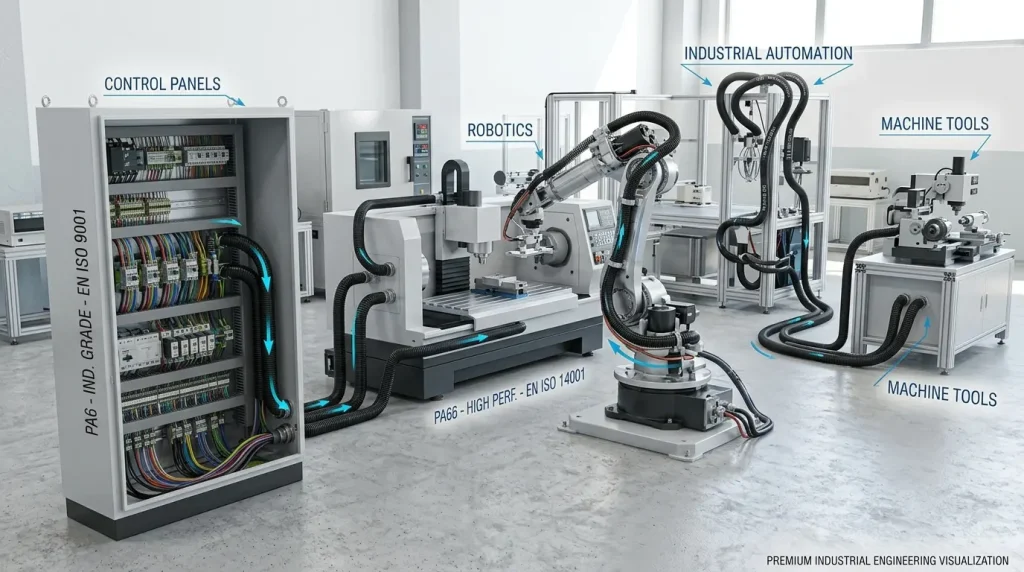
PA6 Conduit Applications
PA6 conduits are widely used because they provide an excellent balance between flexibility, strength, impact resistance, abrasion resistance, and cost.
They are particularly suitable for applications where the conduit needs to move or bend while protecting electrical cables from mechanical damage.
Control Panels
PA6 flexible conduits are commonly used inside electrical control panels to organize and protect groups of wires and cables.
Their flexibility allows installers to route cables around:
- Circuit breakers
- Contactors
- PLCs
- Terminal blocks
- Relays
- Power supplies
- Other electrical components
The results is a cleaner and more organized wiring system that is easier to inspect and maintain.
Industrial Automation
Automation systems often contain numerous sensors, actuators, motors, and communication cables.
PA6 conduit provides flexible protection while allowing cables to be routed between different machine components.
This makes it suitable for:
- Assembly lines
- Packaging equipment
- Conveyor systems
- Automated production machines
- Material handling equipment
Robotics
Robotic applications require special consideration because cables may experience repeated movement.
PA6’s flexibility makes it suitable for many dynamic cable protection applications where repeated bending in involved.
However, for extremely high-cycle robotic applications, engineers should verify the manufacturer’s specific fatigue and bending performance rather than selecting a conduit based solely on it’s material grade.
HVAC Systems
PA6 conduits can also be used for protecting electrical wiring in HVAC equipment.
They provide protection against abrasion, mechanical damage, dust and general environmental exposure while remaining lightweight and easy to install.
PA66 Conduit Applications
PA66 becomes more attractive when the application places greater emphasis on thermal stability, rigidity, mechanical strength, and long-term dimensional stability.
Heavy Machinery
Heavy machinery can generate significant mechanical stress and vibration.
PA66’s greater rigidity and strength can help maintain conduit integrity in these environments.
Applications can include:
- Industrial processing machinery
- Metalworking equipment
- Manufacturing machines
- Large production systems
- Heavy automation equipment
Automotive Manufacturing
Automotive production facilities contain high-speed machinery, robots, welding systems, conveyors, and other equipment that operate continuously.
The combination of heat vibration, movement, and mechanical stress makes material selection particularly important.
PA66 can be advantageous where elevated temperature and mechanical durability are significant considerations.
High-Temperature Equipment
Where electrical wiring is located near heat-generating machinery, PA66 can provide an additional margin of thermal performance compared with standard PA6 applications.
Potential applications include:
- Industrial heating systems
- Engine-related equipment
- High-temperature machinery
- Power-generation systems
- Specialized manufacturing equipment
Again, the exact operating temperature of the finished conduit must be checked against the manufacturer’s specification.
Railway and Transportation Systems
Transportation applications can expose cable protection systems to vibration, temperature fluctuations, mechanical movement, moisture, and demanding service conditions.
PA6 may be considered where higher mechanical stability and thermal performance are required.
However, railway applications often have specific flame, smoke, toxicity, and certification requirements. The material grade alone does not determine whether a conduit is suitable for railway use.
PA6 vs PA66: Which Is More Flexible?
If flexibility is the primary requirement, PA6 generally has the advantage.
Its combination of toughness and flexibility allows it to accommodate bending and movement while remaining resistant to impact and abrasion.
This makes PA6 especially useful when:
- Cable routes contain frequent bends
- Installation space is limited
- The conduit must be manipulated during installation
- Machinery contains moving components
- Ease of installation is important
PA66 generally favours rigidity and mechanical stability over maximum flexibility.
That makes it more appropriate when the conduit must maintain its shape and resist deformation under mechanical and thermal loads.
PA6 vs PA66: Which One Has Better Heat Resistance?
PA66 generally has the advantage in thermal performance.
Its higher thermal stability allows it to retain its mechanical properties more effectively at elevated temperatures.
However, this does not mean PA6 cannot be used in warm industrial environments. PA6 remains suitable for many applications where operating temperatures fall within the product’s specified range.
The correct approach is to compare the actual operating temperature of your application against the manufacturer’s published temperature rating for the finished conduit.
PA6 vs PA66: Which One Is More Durable?
Both materials can provide excellent service life when properly matched to the applications.
PA66 generally offers advantages in:
- Rigidity
- Surface hardness
- Thermal stability
- Dimensional stability
- Mechanical strength
PA6 offers advantages in:
- Flexibility
- Toughness
- Impact resistance
- Ease of installation
- Cost efficiency
Therefore, durability should not be judged by material grade alone.
A PA6 conduit correctly selected for its environment can outperform an incorrectly specified PA66 conduit. The right material is the one whose properties match the actual stresses experienced by the installation.
The Most important point: Material Grade Is Only One Part of Conduit Selection
When selecting an industrial conduit, engineers sometimes focus too heavily on PA6 versus PA66 while overlooking other important specifications.
A proper selection should also consider:
- Conduit size
- Minimum bend radius
- Operating temperature
- Impact resistance
- Compression resistance
- Flame-retardant classification
- UV resistance
- Chemical exposure
- IP rating of the complete system
- Fitting compatibility
- Cable fill
- Dynamic or static installation
- Installation environment
- Applicable industry standards
For example, choosing PA66 does not automatically make a conduit suitable for high-temperature machinery. The finished product must still have a temperature rating appropriate for that environment.
Similarly, selecting PA6 does not automatically mean that the conduit is unsuitable for demanding industrial applications.
The material grade provides the foundation, but the finished product specification determines whether the conduit is actually appropriate for a particular installation.
Practical Decision Guide
A simple way to approach the decision is to start with the primary requirement of the application.
Choose PA6 when:
- Flexibility is a major priority
- The conduit needs frequent bending
- Installation space is limited
- The operating temperature is within the PA6 product specification
- You need a balanced industrial solution
- Cost efficiency is important
Consider PA66 when:
- Higher temperature resistance is required
- Greater mechanical strength is important
- Higher rigidity is beneficial
- Dimensional stability is critical
- The conduit will experience substantial mechanical stress
- Installation operates in a demanding industrial environment
- Long-term resistance to deformation is a major concern
How to Choose Between PA6 and PA66 Conduits
The choice between PA6 and PA66 should not be based simply on which material has better specifications. The correct conduit material depends on the actual electrical installation, environmental conditions, mechanical stress, movement, temperature, and expected service life.
A conduit that performs extremely well in one application may be unnecessary or less suitable in another. For this reason, the selection process should begin with the operating conditions rather that the material name.
Choose PA6 Conduit When Flexibility is a Priority
PA6 is generally the more practical choice when the wiring system requires frequent bending, routing around machinery, or repeated cable movement.
It is particularly suitable when the installation requires:
- High flexibility
- Repeated bending or movement
- Good impact resistance
- Reliable protection for general industrial wiring
- A balanced performance-to-cost solution
PA6 conduits are commonly suitable for industrial automation, control panels, machine tools, HVAC equipment, packaging machinery, and general electrical installations.
For example, when cables need to pass through a confined machine area with multiple bends, a flexible PA6 conduit can make installation considerably easier.
Choose PA66 Conduit When Mechanical Performance is the Priority
PA66 becomes more attractive when the application places greater emphasis on mechanical strength, rigidity, dimensional stability, wear resistance, or elevated-temperature performance.
It may be preferred when the installation involves:
- Higher mechanical loads
- Greater structural rigidity
- Increased surface wear
- Higher operating temperatures
- More demanding industrial environments
- Applications where dimensional stability is particularly important
This makes PA66 a potential choice for heavy machinery, automotive manufacturing equipment, railway systems and demanding industrial installations.
However the actual suitability should always verified against the manufacturer’s technical specifications rather that every PA66 conduit will perform better than any PA6 conduit.
Common Mistakes When Selecting PA6 vs PA66 Conduits
Choosing the wrong conduit material can lead to premature wear, difficult installation, inadequate protection, or unnecessary material costs. Several common mistakes can be avoided by evaluating the complete application.
1.Choosing Only on the Basis of Price
The cheapest conduit is not necessarily the most economical solution.
A lower-cost PA6 conduit may be the correct choice for a flexible automation application, while a more demanding installation may justify a higher-performance PA66 conduit.
The better approach is to compare total application requirements rather than simply comparing purchase prices.
2. Assuming PA66 is always better
PA66 generally offers advantages in rigidity, mechanical strength, and thermal performance, but that does not make it universally superior.
If an application requires high flexibility and repeated movement, excessive rigidity can actually make installation or cable routing less convenient.
The objective is to select the material that matches the application-not simply the material with highest individual specification.
3. Ignoring Temperature Conditions
Ambient temperature, cable temperature, nearby machinery, heat sources, and temporary temperature peaks should all be considered.
A conduit should be selected according to its actual rated operating temperature, including short-term exposure where relevant.
For example, Eleczar’s PA6 polyamide spiral conduit is specified for -40°C to +120°C, with short-term exposure up to 150°C. These are product-specific ratings and should not be generalized to every PA6 conduit.
4. Ignoring Moisture Exposure
Polyamide materials can absorb moisture, which can influence certain mechanical and dimensional properties.
For installations exposed to humidity, water, condensation, or changing environmental conditions, the manufacturer’s environmental and application data should be reviewed before selection.
5. Assuming Chemical Resistance Is Universal
PA6 and PA66 both offer useful chemical resistance, but resistance depends on the specific substance and exposure conditions.
The following factors should be considered:
- Chemical type
- Concentration
- Temperature
- Exposure duration
- Frequency of exposure
- Mechanical stress
- Whether the conduit is continuously or intermittently exposed
A conduit suitable for oil exposure, for example, should not automatically be assumed to be suitable for every solvent or aggressive chemical.
6. Ignoring UV Exposure
For outdoor installations, UV resistance is important.
The UV performance of a finished conduit depends on the polymer formulation, stabilizers, pigmentation, manufacturing process, and product design-not simply whether the base material is PA6 or PA66.
Always check the manufacturer’s outdoor-use and UV-resistance specifications.
7. Selecting the Wrong Conduit Size
Material selection is only one part of cable protection.
The internal diameter must provide sufficient space for the cables without creating excessive compression or making installation unnecessarily difficult.
The number, diameter, bending radius, movement, and future expansion of cables should all be considered.
8. Ignoring Bend Radius
A flexible conduit still has a minimum recommended bending radius.
Forcing a conduit into bends tighter than its recommended radius can increase mechanical stress and may reduce the service life of both the conduit and the cables inside it.
9. Selecting the Conduit Without Considering the Fittings
The conduit and its fittings should be treated as one cable protection system.
Thread type, conduit size, sealing requirements, IP protection, strain relief, mounting method, and environmental exposure should all be compatible.
A high-quality conduit paired with an unsuitable fitting can be compromise the overall installation.
Are PA6 and PA66 Conduits Interchangeable?
Not necessarily.
Although both materials belong to the polyamide family and can be used for cable protection, their mechanical, thermal, moisture-related, and dimensional characteristics are different.
Whether one can replace the other depends on the specific application and the technical requirements of the installation.
Before replacing one with another, compare:
- Operating temperature
- Flexibility requirements
- Mechanical loads
- Abrasion exposure
- Moisture conditions
- Chemical exposure
- Required service life
- Conduit and fitting compatibility
A material substitution should therefore be based on engineering requirements rather than simply matching conduit dimensions.
Frequently Asked Questions
Is PA66 stronger than PA6?
Generally, PA66 offers higher tensile strength, stiffness, hardness, and dimensional stability than PA6. However, PA6 offers an excellent combination of toughness, flexibility, and impact resistance, making it highly suitable for many industrial applications.
Is PA6 more flexible than PA66?
Generally, yes. PA6 is typically more flexible and can be advantageous in applications involving repeated bending, movement, or complex cable routing.
Which is better for high-temperature applications, PA6 or PA66?
PA66 generally provides better thermal performance, but the actual answer depends on the specific conduit construction and its rated operating temperature.
Always compare the manufacturer’s temperature rating rather than selecting solely from the PA6 or PA66 material designation.
Which material is better for industrial automation?
PA6 is often an excellent choice for industrial automation because of its flexibility, impact resistance, abrasion resistance, and suitability for dynamic cable routing.
However, PA66 can be advantageous in automation equipment where higher rigidity, mechanical loading, or thermal performance is required.
Is PA66 worth the additional cost?
It can be, when its additional mechanical, thermal, or dimensional-performance characteristics solve a genuine application requirement.
If those characteristics are not required, PA6 may provide the better overall value.
Does PA6 absorb more moisture than PA66?
PA6 generally has higher moisture absorption than PA66. This can influence dimensional and mechanical behaviour, particularly in humid environments.
For applications where moisture exposure is significant, consult the specific product’s technical documentation.
Which is better for robotics?
There is no universal winner.
For robotics applications involving repeated movement and tight cable routing, PA6 can be highly suitable because of its flexibility and fatigue resistance.
For applications where higher mechanical rigidity, dimensional stability, pr thermal performance is required, a suitable PA66 conduit may be preferable.
The robot’s motion profile, bending radius, cycle frequency, temperature, and mechanical loading should determine the selection.
Which conduit should I choose for outdoor applications?
Outdoor suitability should not be determined solely by choosing PA6 or PA66.
Check the specific conduit for UV resistance, temperature range, weather resistance, moisture exposure, and installation conditions.
How do I select the correct polyamide conduit?
Start by identifying the operating temperature, cable size, required flexibility, bending radius, mechanical loads, moisture, chemical exposure, UV exposure, and installation environment.
Then compare the actual technical specifications of PA6 and PA66 conduit products that meet those requirements.
PA6 vs PA66: The Final Decision
The difference between PA6 and PA66 is not simply a matter of choosing a “better” plastic.
Both materials can provide excellent cable protection, but they are optimized around somewhat different performance priorities.
PA6 is generally the better choice when you need:
- Flexibility
- Repeated bending
- Impact resistance
- Easy installation
- Good abrasion resistance
- Reliable general-purpose industrial performance
- Cost-effective cable protection
PA66 is generally the better choice when you need:
- Higher rigidity
- Greater mechanical strength
- Higher surface hardness
- Better dimensional stability
- Greater thermal capacity
- More demanding mechanical performance
The most important principle is therefore simple:
Select the conduit according to the environment in which it will operate, not simply according to the material name printed on the datasheet.
Temperature, mechanical stress, flexibility, moisture, chemicals, UV exposure, cable movement, conduit dimensions, fittings, and installation conditions all influence the final decision.
For industrial wiring, choosing the correct polyamide grade can improve cable protection, simplify installation, reduce maintenance requirements, and help achieve a longer service life.
Conclusion
PA6 and PA66 are both valuable engineering materials for industrial cable protection, but they offer different performance characteristics.
PA6 provides an excellent balance of flexibility, toughness, impact resistance, abrasion resistance, and cost, making it strong choice for general industrial wiring, automation systems, control panels, machine tools and applications involving repeated cable movement.
However, the material grade should always be evaluated alongside the complete conduit specification. Wall construction, additives, reinforcements, flame-retardant formulation, UV stabilizers, dimensions, fittings, and manufacturing quality can significantly affect the performance of the finished product.
For this reason, the best PA6 vs PA66 decision is not about choosing the strongest material. It is about choosing the right material for the actual operating environment.
For industrial cable protection systems, a properly selected polyamide conduit can provide the combination of mechanical protection, flexibility, durability, and environmental resistance needed to keep electrical wiring protected throughout its service life.