
Introduction
Modern data centers focus on one essential need above all: reliable infrastructure.
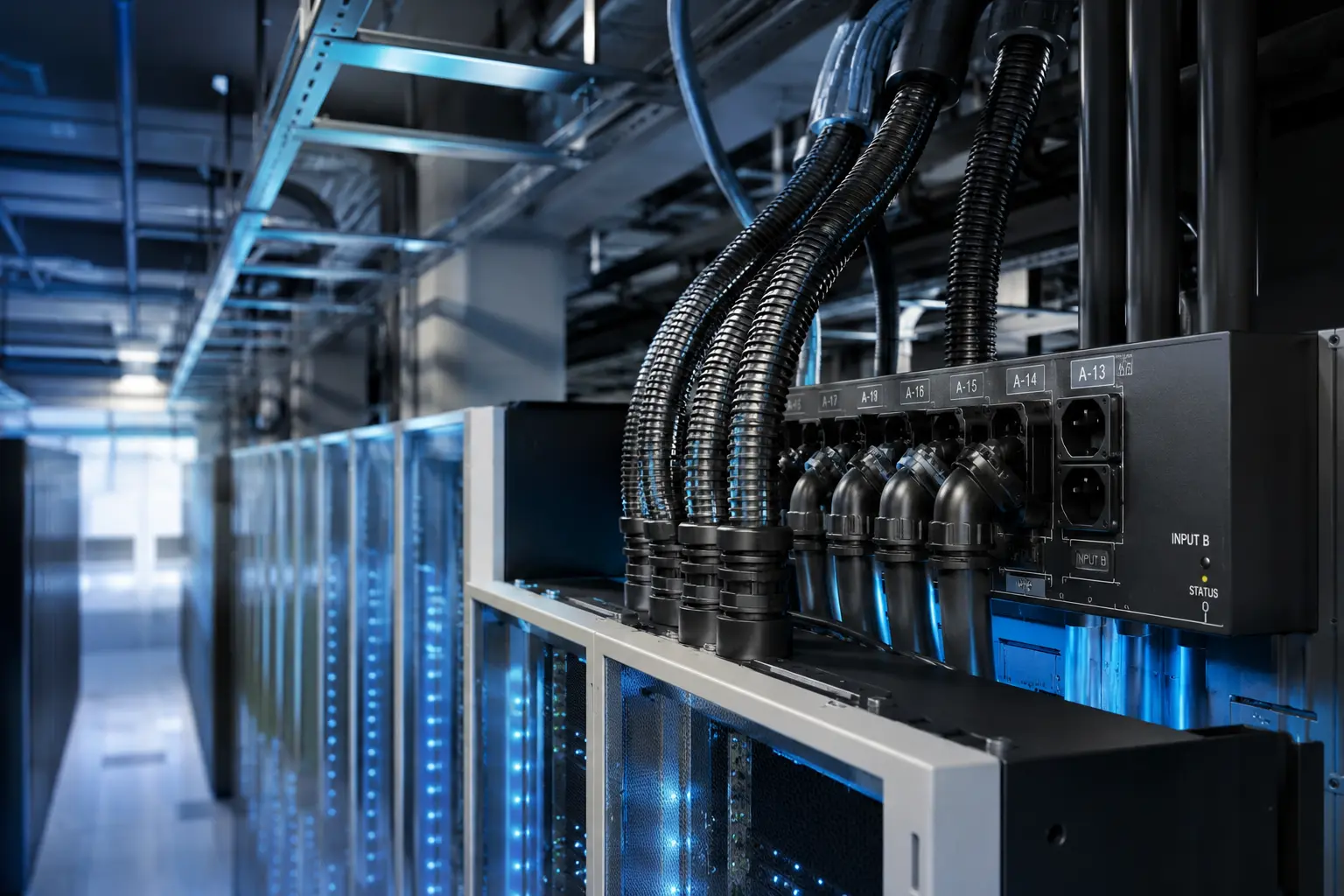
Thousands of servers, networking devices, storage systems, cooling units, UPS systems, power distribution equipment, monitoring systems, security equipment, and control systems may operate continuously inside the same facility. Hidden behind the hardware is a complex network of electrical and communication lines that need management and protection
This is where cable-management and conduit systems become important.
A conduit is much more than a basic tube used to hold wires. It serves as a vital system that protects and organizes cabling based on your specific needs.
Internationally, IEC 61386-1 defines requirements and tests for conduit systems and fittings used for the protection and management of insulated conductors and cables in electrical and communication installations. Flexible conduit systems have additional requirements covered by IEC 61386-23.
However, there is an important point to understand from the beginning:
Conduit is only one part of a data center’s cable-management infrastructure.
Data centers can use conduit, cable trays, ladder systems, raceways, busways, containment systems, and other pathways, with the appropriate system selected according to the cable type, location, installation method, protection requirements, and applicable standards.
BICSI’s data-center guidance, for example, recognizes enclosed raceways such as conduit systems alongside cable trays and other containment methods for telecommunications cabling.
So the real question isn’t simply “What type of conduit is best for a data center?”
It is:
Where does conduit make sense, what type of conduit is appropriate, and what should engineers and procurement teams consider before specifying it?
Why Are Conduits Used in Data Centers?
Data centers are made for uptimes, reliability, maintainability, and controlled infrastructure.
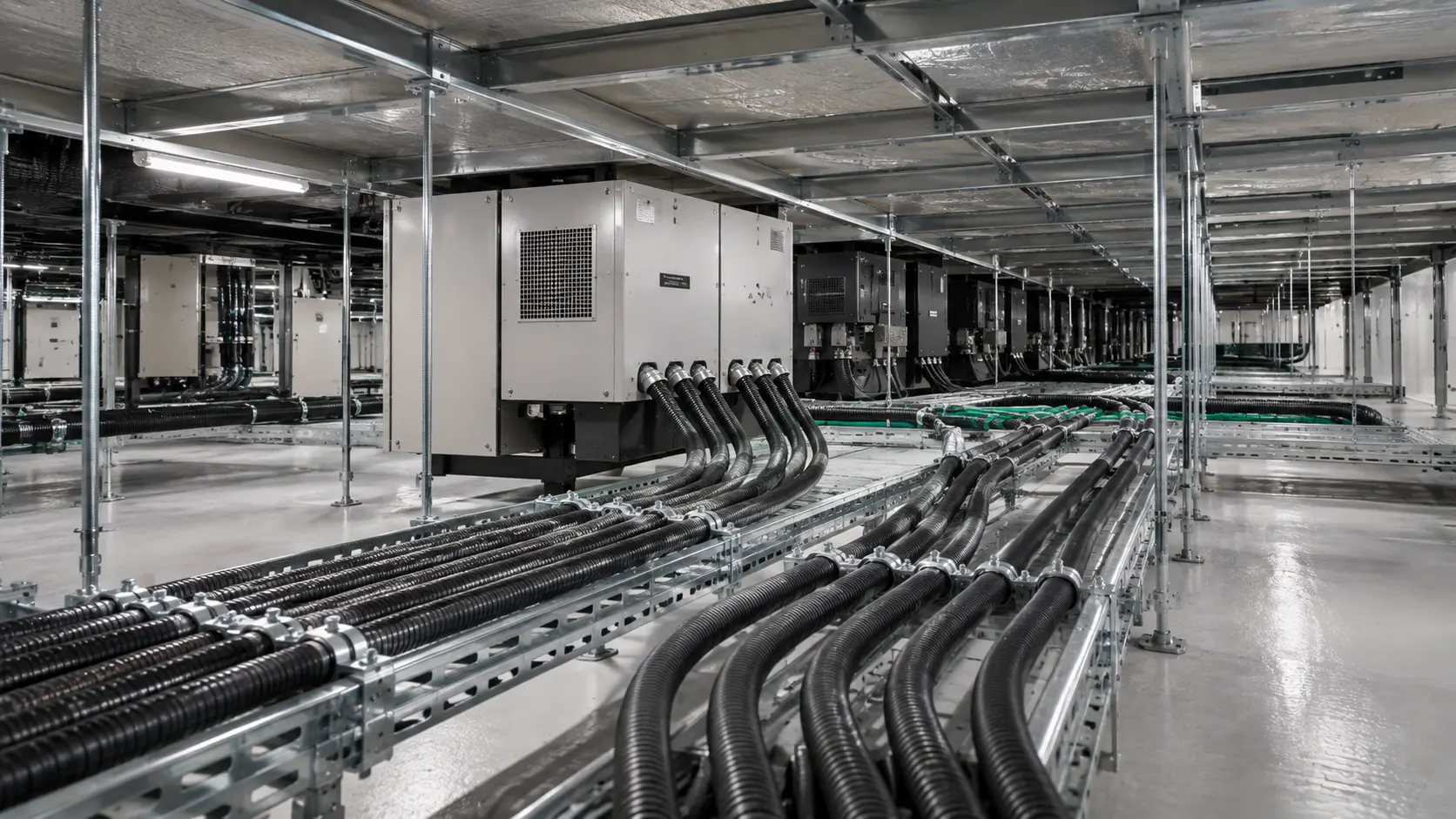
A cable that is simply ran through one piece of equipment to another may be exposed to mechanical damage, environmental conditions, movement, vibration, or difficult routing conditions.
A suitable conduit system can also provide an additional layer of protection around the cable.
Depending on the application, conduits can help with:
- Mechanical protection
- Cable routing
- Environmental protection
- Protection around equipment connections
- Cable organization
- Separation between pathways
- Protection in areas where cables may be exposed to physical damage
- Maintaining a defined pathway for future maintenance
The specific protection provided depends heavily on the conduit material, construction, fittings, installation method, and product rating.
This is why simply specifying “flexible conduit” isn’t enough.
An engineer or procurement team needs to know what the conduit is made from, where it will be installed, what it will protect, and what environmental conditions it will encounter.
Where Are Conduits Used Inside a Data Center?
One thing to keep in mind is that Flexible Conduits are not required everywhere inside a data center.
High-density telecommunications cabling may commonly use dedicated cable trays or other containment systems, while flexible conduit may be more appropriate for specific pathways, equipment connections, external routes, or locations where enclosed mechanical protection is required.
BICSI guidance discusses both enclosed raceway distribution, such as conduit systems, and open cable-tray systems as possible telecommunications containment approaches.
This makes conduit particularly relevant in areas where protection and controlled routing are more important than simply accommodating a large volume of cables.
1. Electrical Power Infrastructure
Electrical power is one of the largest infrastructure systems within a data center.
Power may need to be distributed between:
- Main electrical equipment
- Switchgear
- UPS systems
- Power distribution units
- Remote power panels
- Cooling equipment
- Control equipment
- Generator systems
- Building electrical systems
Conduit systems can offer enclosed routes and mechanical protection for electrical conductors, depending on the installation design and local electrical standards.
The voltage, environment, installation technique, necessary mechanical protection, and relevant electrical code all influence the precise conduit type.
For this reason, it would be deceptive to say that a specific conduit material is appropriate for all data-center power applications.
The installation requirements come first; the conduit is selected to satisfy them.
2. UPS and Power Distribution Equipment
Because they assist in ensuring power continuity for vital loads, UPS systems are essential parts of data-center infrastructure.
Around UPS equipment, there can be substantial amounts of:
- Power cabling
- Control wiring
- Monitoring cables
- Communication wiring
- Battery-system connections
The electrical design and equipment configuration determine the proper route.
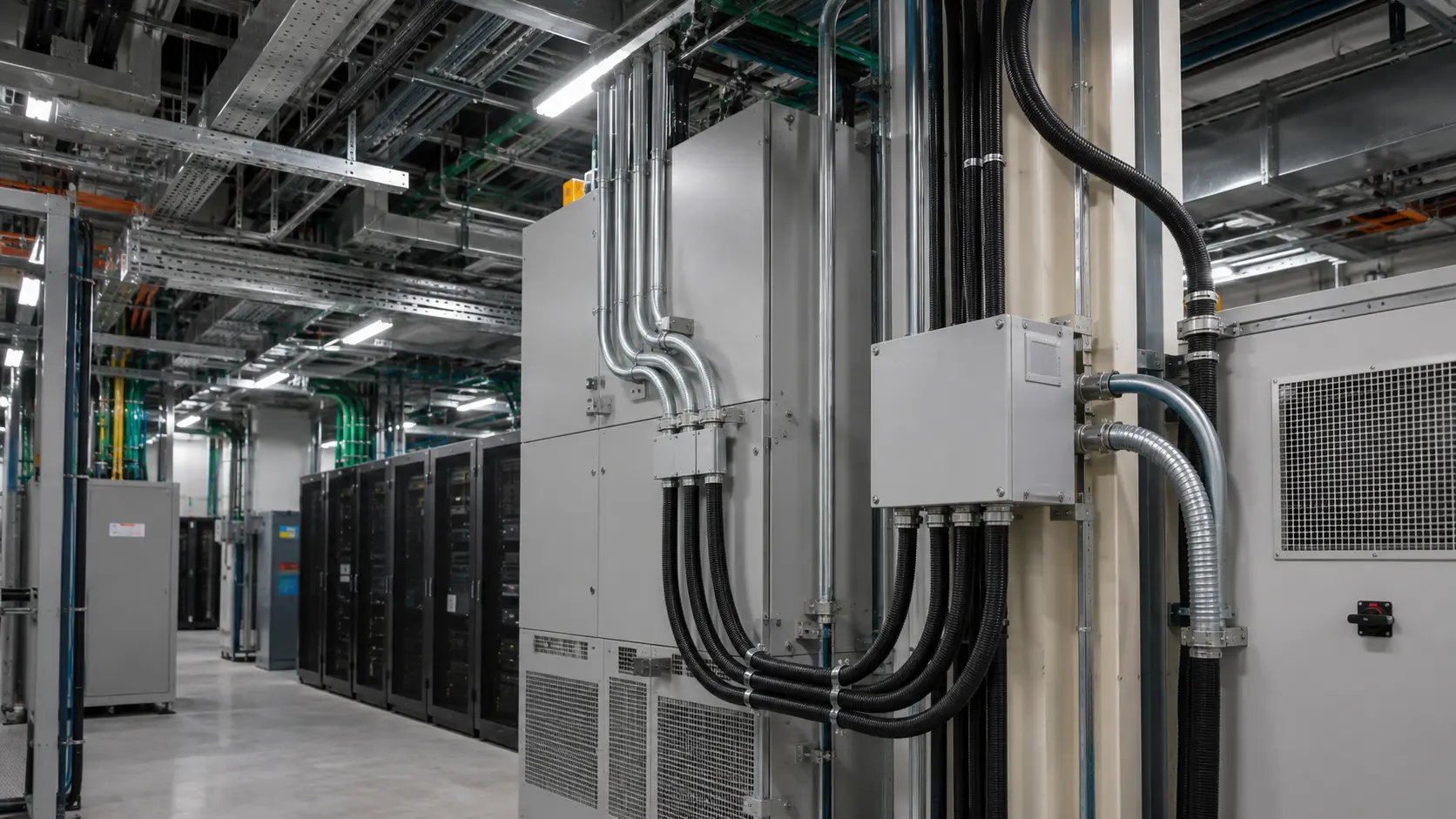
While flexible conduit can be helpful at equipment interfaces where wires must transition into an enclosure or connect to equipment that may encounter vibration or movement, rigid conduit can offer excellent mechanical protection when permanent routing is necessary.
This is one of the areas where flexible conduit can complement rather than replace rigid cable pathways.
3. Cooling and HVAC Equipment
No machine can reliably function Without heat control, a data center cannot function dependably.
Because servers produce heat continuously, the facility’s cooling system is crucial.
The following types of equipment are surrounded by electrical and control cabling:
- CRAH units
- CRAC units
- Chillers
- Pumps
- Fans
- Cooling controls
- Sensors
- Monitoring equipment
Conditions including vibration, dampness, temperature fluctuations, and limited route space may be introduced by these installations.
Flexible conduit can be particularly useful around equipment connections because it can accommodate routing changes and movement more easily than a completely rigid pathway.
However, the conduit and fitting system must have the proper environmental protection for the particular application in cases where moisture or liquid exposure is a possibility.
4. Control Panels and Building Management Systems
Large-scale control and monitoring infrastructure can be found in data centers.
Electrical and communication connections are necessary for building management systems (BMS), environmental monitoring, power monitoring, security systems, HVAC controls, and other automation systems.
These systems can involve numerous smaller cables routed between:
- Sensors
- Control panels
- HVAC equipment
- Monitoring devices
- Automation equipment
- Distribution equipment
At these interfaces, flexible conduit can offer helpful protection, especially when wires need to be attached to equipment or run through small areas.
For an equipment connection, for instance, a flexible polyamide conduit might be taken into consideration if its mechanical, thermal, environmental, and flame-performance properties meet project specifications.
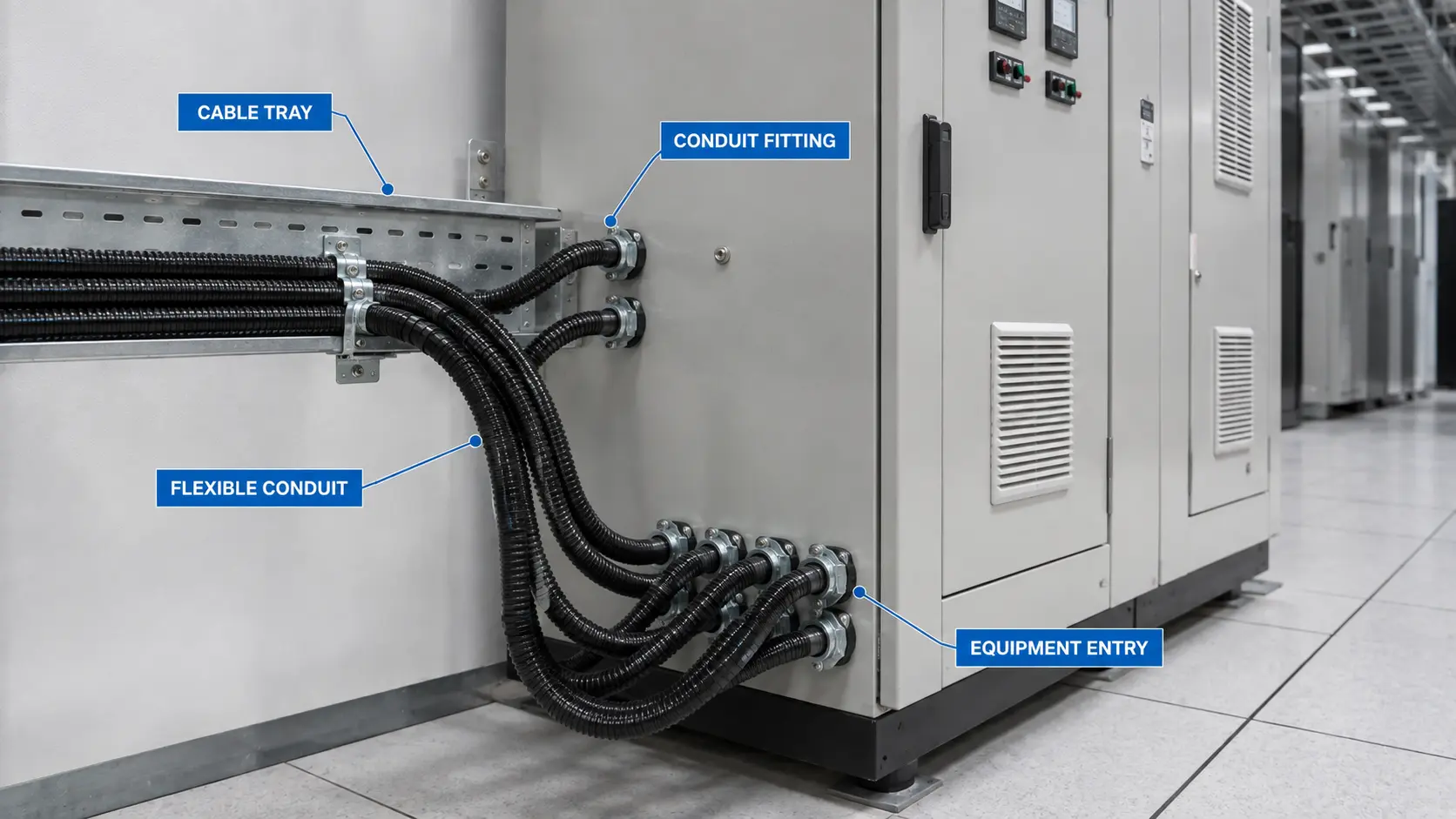
5. Equipment Connections
One of the most useful application for flexible conduit is this.
Consider a fixed cable pathway that ends close to a piece of machinery.
The equipment may:
- Vibrate
- Move slightly during operation
- Require maintenance
- Have a difficult cable-entry position
- Have limited space around the connection
The flexibility required for the final connection might not be provided by a strict approach.
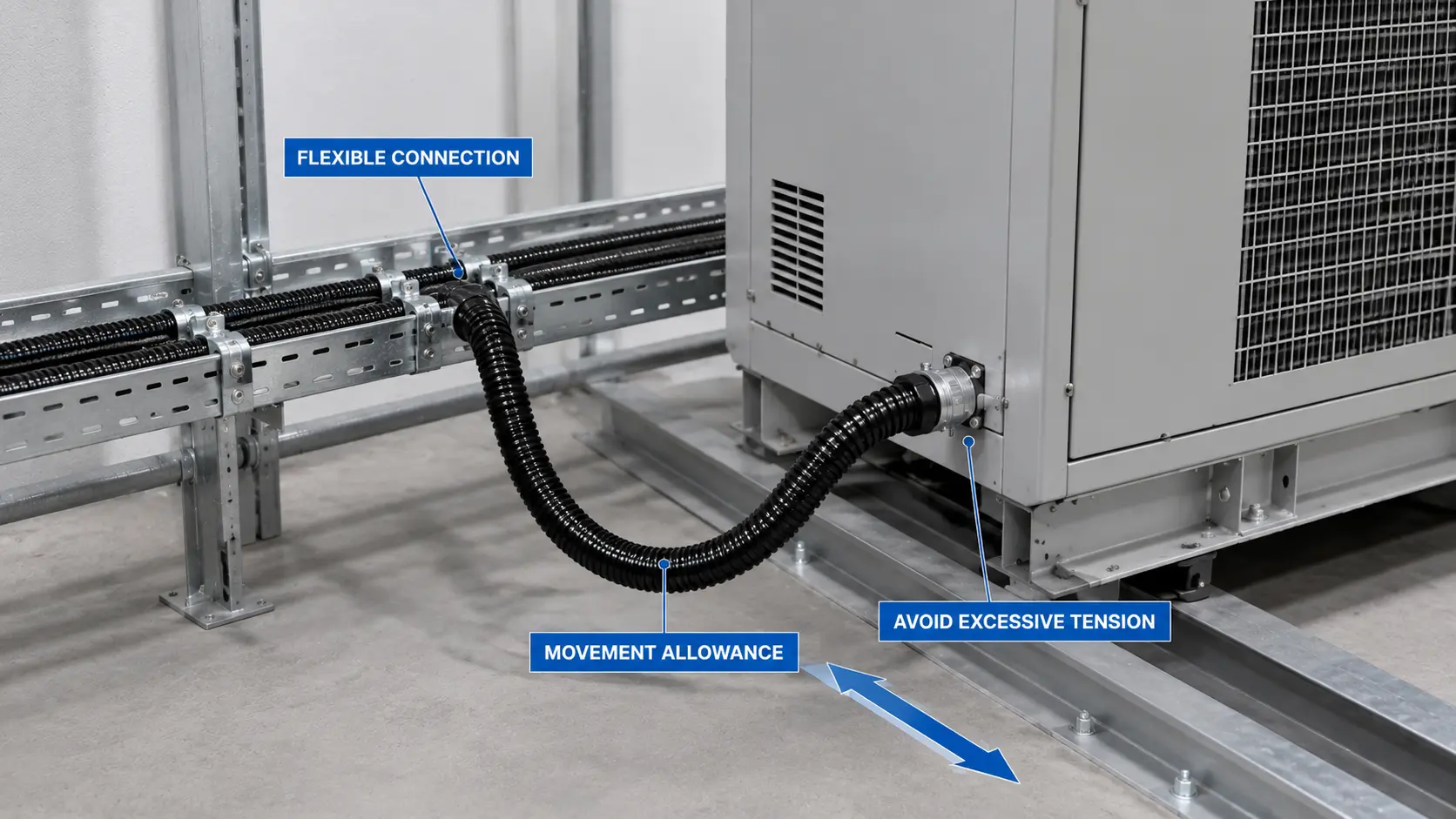
That transition can be bridged using a flexible conduit.
While enabling the cable protection system to handle the necessary bend and movement, the conduit can direct the cable from the fixed course toward the equipment.
Instead of considering the entire data center as a single continuous conduit installation, this is especially important when it comes to mechanical and electrical equipment.
Conduit vs Cable Tray in Data Centers
Particular consideration should be given to this distinction.
Because both conduit and cable tray are used to transport cables, it is simple to believe that they serve the same purpose.
They don’t.
Cable Tray
The typical purpose of a cable tray is to support and arrange groups of cables along a pathway.
When a facility needs to route a lot of wires, it can be especially helpful.
Conduit
Depending on its design and rating, conduit can offer further mechanical and environmental protection in addition to providing a enclosed passage around the cable or conductors.
So that, the conduit is especially helpful for some routes and equipment connections where an enclosed pathway is preferred.
Why Flexible Conduit Can Be Important
Flexible conduit has a particular advantage that rigid conduit cannot easily replicate:
It can bend.
That sounds obvious, but it becomes important when cables have to connect to equipment.
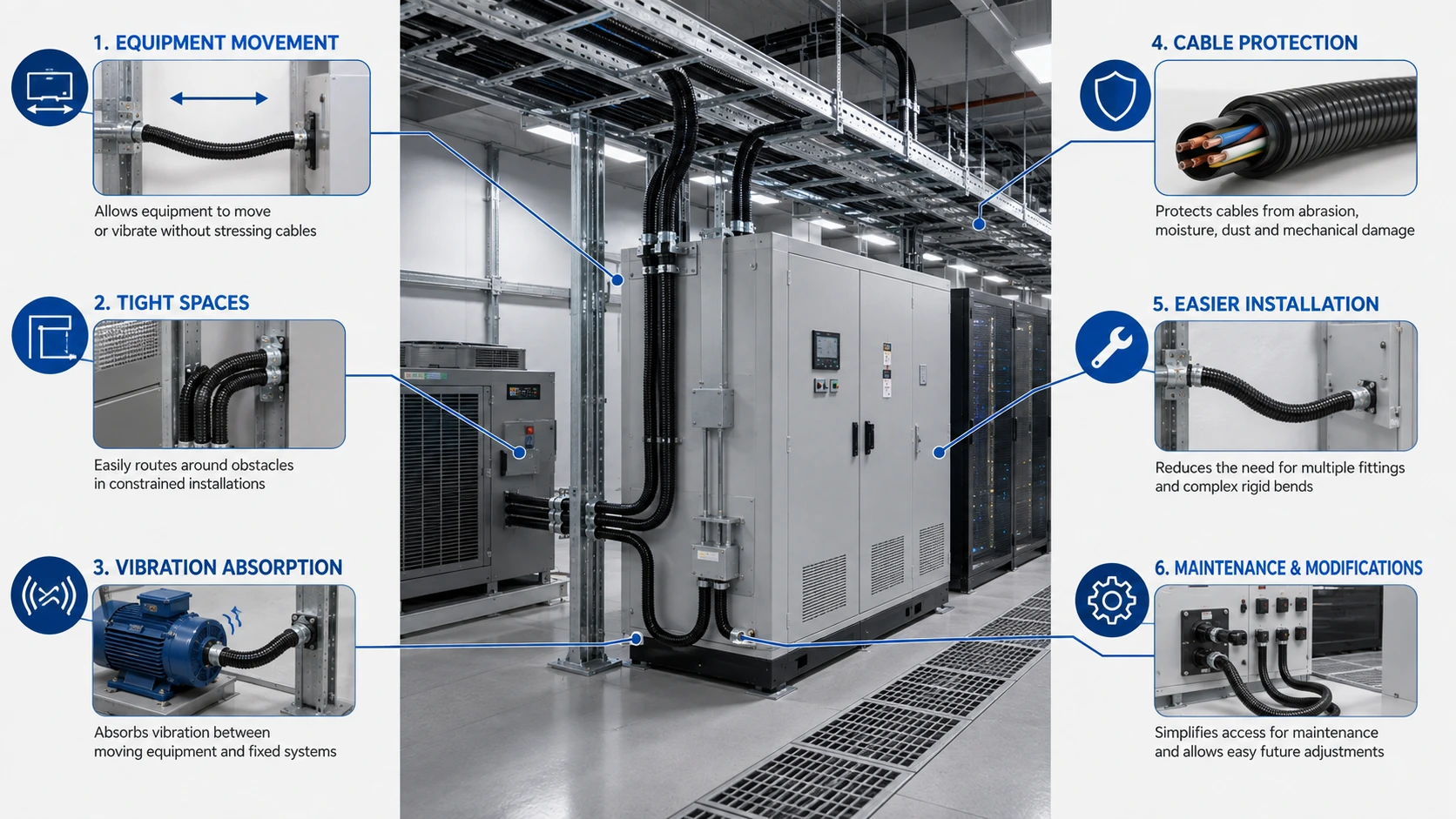
A flexible conduit can help accommodate:
- Tight routing
- Equipment connections
- Vibration
- Limited movement
- Changes in direction
- Difficult installation geometry
IEC 61386-23 specifically establishes requirements for flexible conduit systems, making it an important reference when evaluating flexible conduit products and systems.
However, flexibility should not be confused with unlimited movement.
The conduit still has a specified bending capability, mechanical properties, and application limits.
The cable inside also has its own minimum bend radius and installation requirements.
Data Center Conduit Is About More Than Cable Protection
A good conduit selection isn’t simply:
Cable → Conduit → Done.
A data-center pathway needs to be considered as part of the larger infrastructure.
Engineers may need to evaluate:
- Cable type
- Cable quantity
- Conduit diameter
- Internal fill
- Bend radius
- Mechanical protection
- Temperature
- Moisture
- Chemical exposure
- Fire performance
- Smoke characteristics
- EMI considerations
- Fittings
- Grounding and bonding where applicable
- Accessibility
- Future expansion
- Applicable standards and local codes
For example, Oracle’s published data-center pathway requirements specify limits on conduit fill, bend arrangement, route diversity, and fire-stopping at wall penetrations for its particular infrastructure. These are project-specific requirements, not universal rules for every data center.
That distinction is important.
A product should not be selected simply because it is marketed as “data-center compatible.”
The product’s actual technical specifications need to match the project’s requirements.
Why Cable Protection Is Critical in a Data Center
Beyond simply replacing a damaged cable, a cable failure might have far-reaching effects.
Depending on what the cable supports, a failure could affect:
- Power distribution
- Cooling
- Monitoring
- Building management
- Communications
- Security
- Network connectivity
- Equipment availability
For this reason, serviceability and dependability are taken into consideration when designing cable paths.
Instead of just designing around the cables that are there on day one, data center design guidelines place an emphasis on preparing for future capacity and adequately sized passageways.
Thus, both present needs and future developments must be taken into account in a well-designed cable-management system.
The Three Questions to Ask Before Selecting a Data Center Conduit
Three fundamental questions should be addressed by an engineer or procurement team prior to selecting a conduit:
1. What cable is being protected?
The needs for power cable, control cable, communication cable, fiber, sensor wiring, and other cable types can vary greatly.
2. Where will the conduit be installed?
Conduit located outside, underground, close to cooling equipment, or in a location susceptible to mechanical damage is subject to quite different conditions than conduit utilized inside a control cabinet connection.
3. What does the conduit need to withstand?
This could include:
- Bending
- Impact
- Compression
- Pulling forces
- Vibration
- Temperature
- Moisture
- Chemicals
- UV exposure
- Fire-related
- requirements
Once these questions are answered, selecting between metallic, liquid-tight, polyamide, or another conduit system becomes much more straightforward.
Types of Conduits Used in Data Center Applications
The type of conduit needed for each cable pathway in a data center varies. The cable being covered, the installation environment, mechanical requirements, temperature, moisture exposure, movement, fire-performance requirements, and relevant standards all influence the best option.
Conduit selection should therefore start with the application rather than a specific product or material.
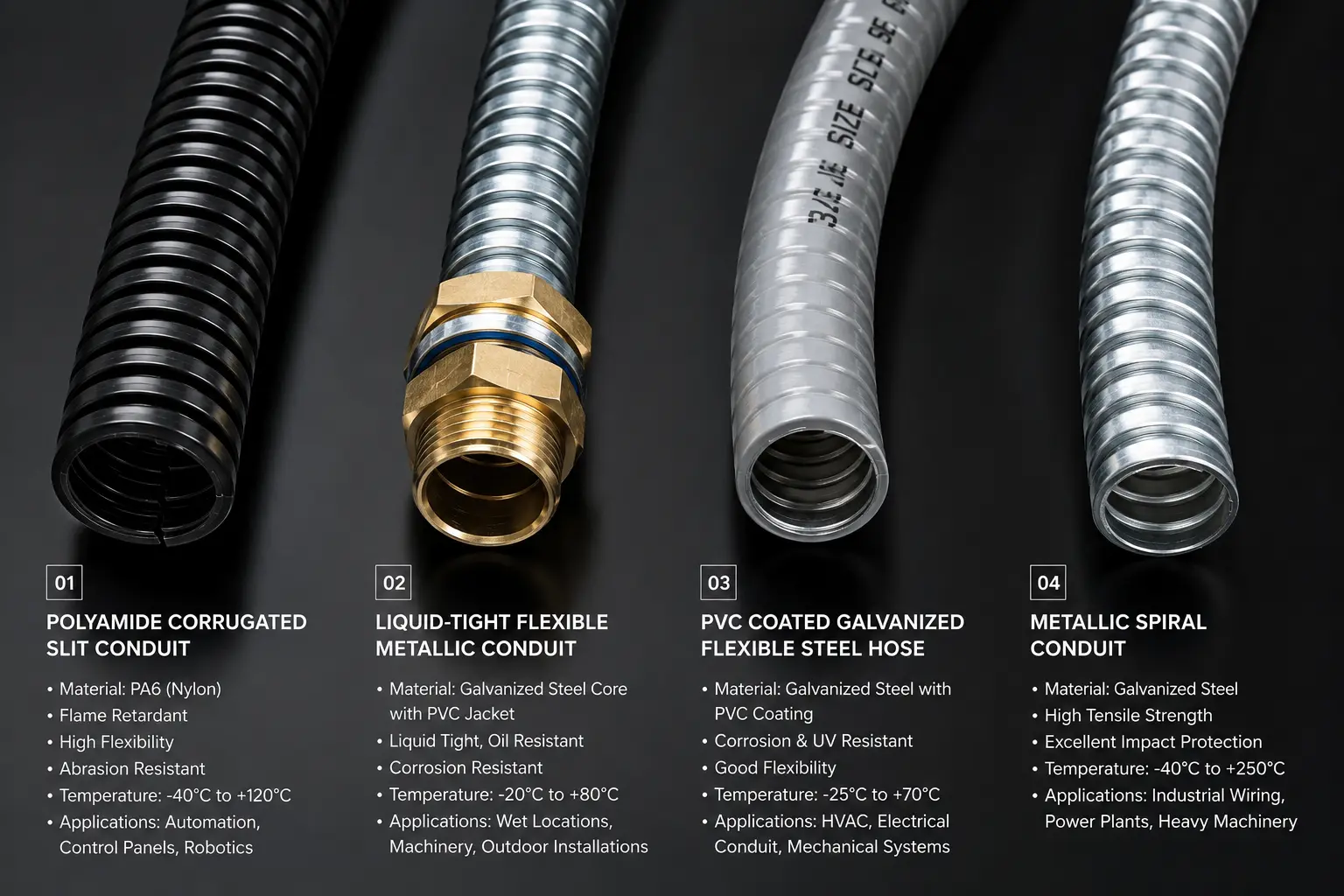
Metallic conduit, flexible metallic conduit, liquid-tight flexible conduit, non-metallic conduit, and flexible polyamide conduit are the primary conduit types that can be found in data-center electrical and equipment infrastructure.
—
1. Rigid Metallic Conduit
When a fixed cable channel and robust mechanical protection are needed, rigid metallic conduit is utilized.
Metallic conduit is frequently chosen for installations where wires may be subjected to physical damage or when a sturdy enclosed passage is necessary. It can be made from materials like steel.
Typical characteristics include:
- High mechanical protection
- Rigid construction
- Good impact resistance
- Suitable for fixed routing
- Long service life when correctly specified and installed
- Compatibility with appropriate metallic fittings and accessories
For certain electrical paths, equipment connections, or locations where the project specification calls for a higher degree of mechanical protection, rigid metallic conduit may be taken into consideration in a data center.
Rigid conduit isn’t always the best option, though, for all equipment connections.
Installing a hard pathway can be challenging if the cable must frequently change direction or if flexibility is needed for the final connection to equipment.
Flexible conduit systems are helpful in this situation.
2. Flexible Metallic Conduit
The mechanical properties of a metallic construction are combined with the flexibility to bend during installation in flexible metallic conduit.
Flexible conduit can handle more intricate routing rather than requiring stiff sections and fittings to create every direction change.
This can be particularly useful around:
- Electrical panels
- Motors
- HVAC equipment
- Pumps
- Control equipment
- Generators
- Mechanical equipment
Flexibility in installation is the main benefit.
Where it would be challenging to design a totally rigid passage, a flexible metallic conduit can help handle equipment connections.
However, the conduit’s architecture determines the precise performance.
Factors such as:
- Interlock design
- Strip thickness
- Coating
- Tensile strength
- Crush resistance
- Bend radius
- Temperature rating
should be checked against the requirements of the installation.
3. Liquid-Tight Flexible Metallic Conduit
Certain parts of a data center may be exposed to moisture, condensation, lubricants, cleaning solutions, or other environmental factors.
A typical flexible metallic conduit might not offer the necessary amount of environmental protection in certain situations.
When utilized with appropriate fittings, a liquid-tight flexible conduit combines a flexible metallic core with an exterior protective covering intended to offer extra environmental protection.
This type of conduit can be particularly relevant around equipment such as:
- Cooling systems
- Pumps
- HVAC equipment
- Outdoor equipment
- Generator systems
- Mechanical equipment
- Areas exposed to moisture
It is crucial to consider the conduit and fittings as a complete system.
The mere fact that a liquid-tight conduit has a protective covering does not automatically grant it a certain IP or environmental certification.
The final level of protection is determined by the actual product specification and properly installed fittings.
4. PVC and Other Non-Metallic Conduits
When their unique qualities meet the project requirements, non-metallic conduit systems can also be utilized in electrical installations.
Among their benefits are:
- Low weight
- Corrosion resistance
- Ease of cutting and installation
- Electrical insulation
- Resistance to certain environmental conditions
Non-metallic conduit, however, should never be chosen just because it is cheap or light.
Engineers must look at:
- Flame performance
- Operating temperature
- Impact resistance
- Compression resistance
- Chemical compatibility
- UV resistance
- Smoke characteristics where specified
- Installation environment
In vital infrastructure,
fire performance is especially crucial. The requirements of a given data center project may not always be met by a material that performs well in a broad electrical system.
5. PA6 Polyamide Flexible Conduit
PA6 polyamide flexible conduit is particularly interesting for applications where flexibility, low weight, fatigue resistance, and cable protection are important.
Polyamide 6 is an engineering thermoplastic rather than a simple commodity plastic. The material can provide a useful combination of:
- Flexibility
- Mechanical strength
- Abrasion resistance
- Fatigue resistance
- Low weight
- Chemical resistance
- Temperature resistance
The actual performance depends on the specific grade and construction of the conduit.
For example, a PA6 conduit may be useful for protecting cables around:
- Control panels
- HVAC equipment
- Automation equipment
- Monitoring systems
- Electrical enclosures
- Equipment connections
- Machinery within supporting data-center infrastructure
The key advantage is that the conduit can provide cable protection without the weight associated with many metallic alternatives.
Why PA6 Can Be Useful Around Data-Center Equipment
Data centers contain a significant amount of supporting mechanical and electrical equipment.
The cable does not always run directly through a rigid pathway from point A to point B.
Instead, it may need to connect a fixed cable tray or pathway to equipment that has:
- A moving connection
- Vibration
- Limited installation space
- Multiple changes in direction
- A difficult cable-entry position
A flexible PA6 conduit can accommodate these routing conditions more easily than a rigid conduit.
For example, consider a cooling unit connected to a fixed electrical pathway.
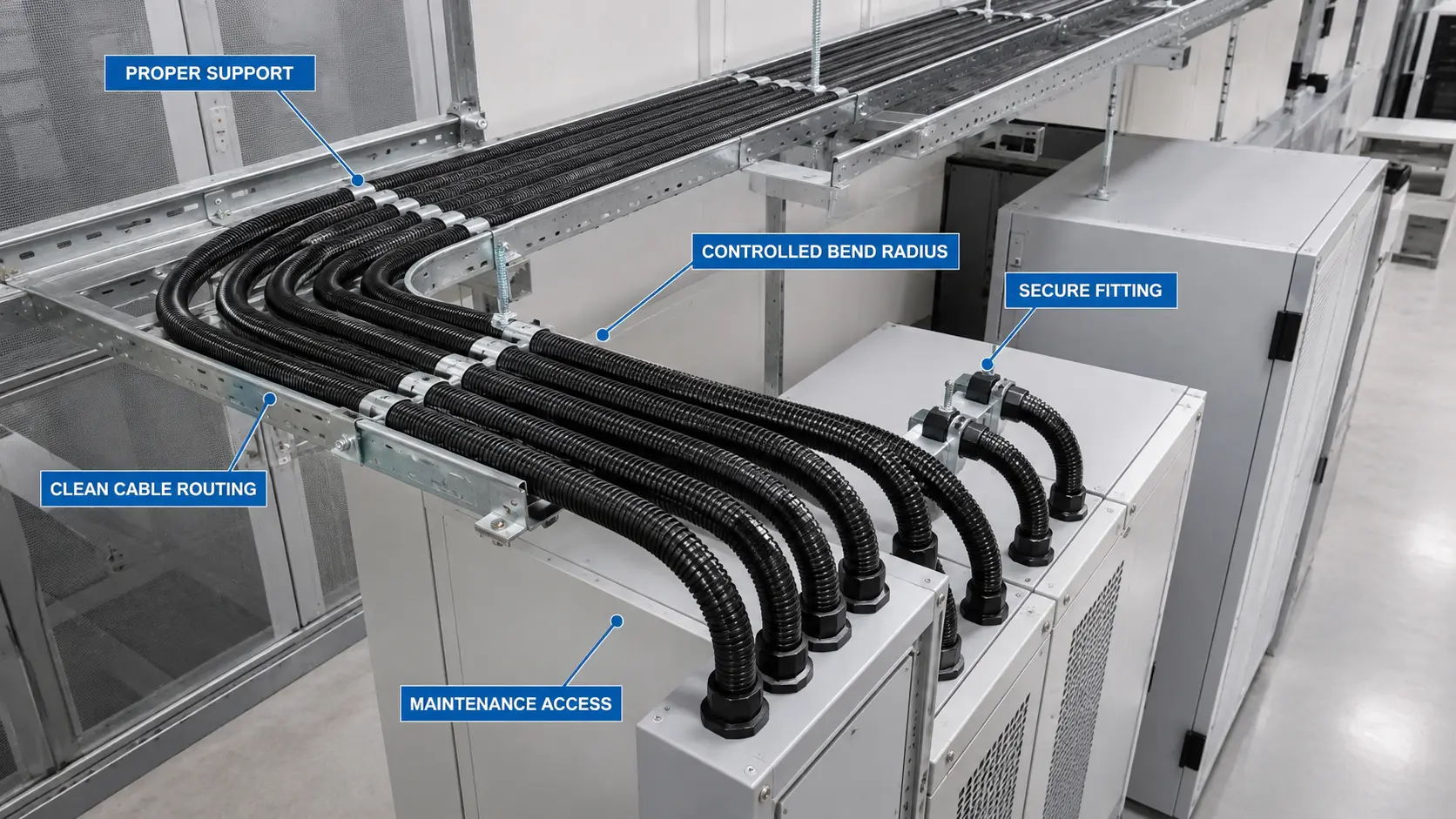
The main cable route may use a tray or rigid pathway, while the final connection to the equipment could use flexible conduit.
This creates a practical arrangement:
Main pathway → cable tray → flexible conduit → equipment
The flexible section provides the movement and routing flexibility required at the equipment interface.
6. Single-Interlock and Double-Interlock Metallic Flexible Conduit
Metallic flexible conduits can also differ in their mechanical construction.
Two common constructions are single interlock and double interlock.
Single Interlock
Single-interlock conduit uses a single interlocking metallic construction.
Its characteristics can include:
- Good flexibility
- Relatively low weight
- Easier routing
- Suitable for many general-purpose applications
It can be useful where flexibility and straightforward installation are important.
Double Interlock
Double-interlock construction adds additional mechanical reinforcement to the interlocking structure.
This can provide advantages where greater mechanical robustness is required.
Depending on the specific product, it can be considered for applications involving:
- Heavy machinery
- Greater mechanical stress
- Continuous industrial vibration
- More demanding routing environments
The important point is that double interlock should not automatically be interpreted as “better for every application.”
It may provide greater mechanical robustness, but the selection should still be based on the actual requirements of the installation.
7. PVC-Coated Flexible Metallic Conduit
It is also possible to provide a PVC outer coating for a metallic flexible conduit.
While the PVC coating offers an extra outer layer, the metallic core offers mechanical protection.
When the installation calls for a combination of the following, this construction may be helpful: The combination of mechanical protection, flexibility, and external environmental protection Flexible metallic conduit covered with PVC can be thought of as follows:
- Control panels
- HVAC systems
- Industrial equipment
- Generator systems
- Pumps
- Electrical equipment
- Machinery connections
Additionally, compared to exposed metal, the coating may offer a smoother exterior surface, which may be helpful for routing and installation. The manufacturer’s technical specification should always be used to determine the actual temperature, UV, chemical, flame, and environmental performance.
Comparing Common Conduit Types
| Conduit Type | Main Strength | Typical Data-Center Relevance |
|---|---|---|
| Rigid metallic | High mechanical protection | Fixed electrical pathways |
| Flexible metallic | Flexibility + mechanical protection | Equipment connections |
| Liquid-tight flexible metallic | Flexibility + environmental protection | HVAC, cooling, outdoor/mechanical areas |
| PVC/non-metallic | Lightweight + corrosion resistance | Applications meeting project specifications |
| PA6 polyamide | Lightweight + flexibility + fatigue resistance | Equipment and control connections |
| PVC-coated flexible metallic | Mechanical + external protective coating | Equipment and industrial connections |
This table should be treated as a general selection guide, not a substitute for project specifications, applicable codes, or product datasheets.
How Should Engineers Choose Between Metallic and Polyamide Conduit?
There isn’t a universal answer.
The decision should be based on what the conduit needs to accomplish.
Choose a metallic solution when:
- High mechanical protection is required
- The installation is exposed to significant physical damage
- The project specification requires metallic conduit
- The application requires particular grounding/bonding arrangements
- A robust fixed or flexible metallic pathway is appropriate
Consider PA6 polyamide when:
- Low weight is advantageous
- High flexibility is required
- The conduit is being used around equipment
- Repeated bending or movement is involved
- Abrasion resistance is important
- The application’s temperature and environmental requirements are compatible with the selected PA6 grade
The important thing is to avoid selecting conduit based on material name alone.
“Metal” and “PA6” tell you what the conduit is made from. They don’t tell you whether it is suitable for your particular installation.
What Should You Check on the Technical Datasheet?
Before purchasing a conduit for a data-center application, the technical datasheet should be examined carefully.
At minimum, look for:
Material
Determine whether the conduit is made from:
- Galvanized steel
- Stainless steel
- PA6
- PVC
- Another specified material
Temperature Range
Check both:
- Continuous operating temperature
- Short-term temperature, where specified
The conduit must remain within its rated operating range under actual site conditions.
Mechanical Performance
Depending on the application, check:
- Tensile strength
- Impact resistance
- Compression resistance
- Flexibility
- Fatigue performance
Flame Performance
Look for applicable flame-retardancy or flammability classifications.
Do not assume that all PVC or polyamide conduits have the same fire performance.
UV Resistance
If the conduit will be exposed to sunlight or installed outdoors, verify that the specific product is rated for UV exposure.
Chemical Resistance
Check compatibility with the chemicals or fluids present in the installation environment.
Bend Radius
The minimum bend radius is particularly important for flexible conduit.
A conduit that fits the cable bundle but cannot achieve the required bend radius is not an appropriate selection.
The Conduit Is Only One Part of the System
The fitting is one of the conduit selection factors that is most frequently disregarded. The entire installation may be jeopardized by a high-quality conduit attached to an inappropriate fitting.
The entire system could consist of:
Cable → Conduit → Connector → Gland/Fitting → Equipment
Every part must work together. Thus, engineers ought to confirm:
- Thread compatibility
- Conduit-to-fitting compatibility
- Sealing requirements
- IP/environmental rating
- Temperature range
- Mechanical retention
- Grounding/bonding requirements where applicable
This is especially important for liquid-tight and metallic conduit systems.
Why Conduit Diameter Matters in Data Centers
Selecting the right material is only half the job.
The conduit must also have sufficient internal capacity for the cable bundle.
A conduit that is too small can make cable installation difficult and increase mechanical stress during pulling or routing.
An excessively packed conduit can also make future maintenance more difficult.
The basic process is:
Count the cables → Measure cable diameter → Calculate bundle area → Apply appropriate fill allowance → Check internal diameter → Verify bend radius → Select the appropriate standard size.
The correct fill requirement depends on the installation, applicable code, and project specification.
This is particularly important in data centers because future expansion is often considered during infrastructure planning.
A pathway designed only for today’s cable count may become difficult to maintain when additional equipment is installed later.
Don’t Select Conduit Solely on Price
Cost is obviously important in procurement, but conduit is part of an infrastructure system that may be expected to operate for many years.
A cheaper conduit may not be the better choice if it has:
- Insufficient mechanical protection
- Poor environmental resistance
- Inadequate temperature range
- Incompatible fittings
- Insufficient flexibility
- Poor flame performance
- Inadequate bend radius
The better purchasing question is:
Does this conduit meet the technical requirements of the installation at the required lifecycle cost?
That is a much more useful question than simply comparing the price per meter.
How to Select the Right Conduit for a Data Center
For a data center project, choosing a conduit involves more than just deciding on a diameter and running cables through it. The electrical, mechanical, cooling, communication, monitoring, and safety systems found in data centers, which run constantly, may have rather distinct cable-protection needs.
Therefore, the best conduit will depend on
where it will be installed, what it will protect, what environmental conditions it will encounter, and what standards or project specifications apply.
1. Start With the Application
The first question should always be:
What exactly is the conduit being used for?
The standards for a conduit used for a fixed electrical passage may be quite different from those for a conduit protecting a cable connection to an HVAC unit.
Before selecting a product, identify:
- Cable type
- Number of cables
- Cable diameter
- Installation location
- Fixed or moving application
- Indoor or outdoor installation
- Exposure to moisture
- Temperature
- Mechanical stress
- Vibration
- Chemical exposure
- Required fire performance
- Required environmental protection
- Applicable standards
This prevents a common procurement mistake: selecting a conduit first and trying to make the installation fit the product afterward.
2. Select the Correct Conduit Diameter
Once the application is understood, determine the required conduit size.
The internal diameter (ID) is particularly important because this is the space actually available for the cables.
The basic process is:
Measure cable OD → Calculate total cable area → Apply appropriate fill allowance → Determine required internal diameter → Select the next suitable conduit size.
Do not assume that the nominal conduit size represents the usable internal space.
Different conduit constructions and wall thicknesses can produce different internal diameters even when their nominal sizes appear similar.
For a detailed calculation, the cable bundle should also be evaluated for:
- Number of cables
- Cable arrangement
- Bend radius
- Installation method
- Pulling requirements
- Future additions
An appropriately sized conduit should provide enough room for installation without unnecessarily increasing the conduit size.
3. Consider Cable Fill
When several wires are run through the same conduit, cable fill becomes very crucial.
In addition to making installation more challenging, overfilling may leave insufficient space for cable movement or upkeep.
A useful design principle is:
The objective is not to fit the maximum possible number of cables into the conduit. The objective is to provide a practical and maintainable cable pathway.
The allowed fill is determined by the project specification, conduit system, cable arrangement, installation type, and applicable electrical code.
For instance, for the specific pathway application outlined in its documentation, Oracle’s data-center pathway specifications stipulate a maximum conduit fill of 40%. This shouldn’t be taken to mean that every data center must meet the 40% criteria.
The relevant standard and project criteria should be prioritized over general guidelines when creating or specifying a system.
4. Check the Bend Radius
A significant amount of equipment is crammed into thoughtfully designed spaces in data centers. As a result, cables and conduits may need to shift course to avoid obstacles like walls, panels, equipment, and other infrastructure.
This makes bend radius an important consideration.
A conduit should be capable of making the required bends without:
- Kinking
- Excessive deformation
- Damaging the cable
- Creating excessive pulling resistance
- Restricting cable movement
There are actually two bend-radius considerations:
Conduit bend radius
The conduit itself has a minimum bending capability.
Cable bend radius
The cable inside the conduit also has a manufacturer’s specified minimum bend radius.
The installation must satisfy both.
A flexible conduit can make routing easier, but it does not mean the conduit can be bent indefinitely or that the cable inside can tolerate unlimited bending.
5. Static vs Dynamic Installations
This distinction is particularly important when selecting flexible conduit.
Static installation
A static installation does not experience significant repeated movement.
Examples can include:
- Fixed control panels
- Stationary equipment
- Fixed electrical connections
The primary requirements may be mechanical protection, routing, environmental resistance, and installation convenience.
Dynamic installation
A dynamic installation involves repeated movement.
Examples can include:
- Automated equipment
- Moving machinery
- Robotic systems
- Equipment with moving joints
Here, the conduit may need to withstand repeated bending and flexing.
The selection should therefore consider:
- Flexibility
- Fatigue resistance
- Minimum bend radius
- Cable movement
- Cycle frequency
- Abrasion
- Mechanical stress
A conduit suitable for a stationary connection should not automatically be assumed to be suitable for continuous dynamic movement.
6. Temperature Requirements
Temperature is another important factor that can easily be overlooked.
A data center may contain areas with very different thermal conditions.
Consider:
- Server rooms
- Electrical rooms
- Generator areas
- UPS rooms
- Battery areas
- Cooling equipment
- Outdoor equipment
- Rooftop installations
The conduit must have an operating-temperature range appropriate for the actual installation.
When reviewing a datasheet, look for both the minimum and maximum operating temperature.
For polymeric conduits, temperature can also influence mechanical characteristics and flexibility.
For metallic conduits, temperature can affect coatings, seals, and associated fittings.
The conduit should therefore be selected as a complete system rather than judging temperature performance from the conduit material alone.
7. Moisture and Liquid Exposure
Not every data-center environment is completely dry.
Cooling infrastructure, condensation, outdoor equipment, maintenance activities, and certain mechanical systems can introduce moisture.
Where liquid exposure is expected, the conduit system may need additional environmental protection.
This is where liquid-tight flexible conduit can become relevant.
However, the term “liquid-tight” should not be treated as a universal guarantee of protection under every condition.
The actual rating depends on:
- Conduit construction
- Fittings
- Installation
- Sealing
- Product certification
- Environmental conditions
The conduit and fittings should therefore be specified together.
8. Fire and Flame Performance
Fire safety is one of the most important considerations in critical infrastructure.
Conduit material should be evaluated according to the fire-performance requirements of the project.
Depending on the application, engineers may need to consider:
- Flame propagation
- Flammability classification
- Smoke generation
- Halogen content
- Fire resistance
- Fire-rated penetrations
- Fire stopping
The requirements can vary significantly between jurisdictions and applications.
This means it is not enough to write:
“Use fire-resistant conduit.”
A proper specification should identify the required performance classification or applicable standard.
9. Wall and Floor Penetrations
A conduit passing through a wall or floor creates another important consideration.
If the wall or floor forms part of a fire-rated barrier, the penetration must be treated appropriately.
An incorrectly sealed penetration can compromise the intended performance of the barrier.
Data-center pathway guidance can include requirements for fire stopping at penetrations, depending on the particular project and jurisdiction.
Therefore, conduit selection should consider not only the conduit itself but also:
Conduit + fitting + penetration + sealing/fire-stop system
10. Mechanical Protection
Ask what could physically happen to the conduit after installation.
Could it be:
- Hit by equipment?
- Compressed?
- Stepped on?
- Exposed to vibration?
- Pulled during maintenance?
- Subjected to repeated bending?
If mechanical damage is a significant possibility, a more mechanically robust conduit system may be appropriate.
Metallic conduit can provide substantial mechanical protection in many applications.
Flexible metallic constructions can provide a compromise between mechanical protection and routing flexibility.
Polyamide conduit can offer a lightweight solution where its mechanical properties satisfy the application’s requirements.
The manufacturer’s impact, compression, tensile, and other mechanical ratings should be checked rather than making assumptions based purely on material type.
11. Chemical and Environmental Resistance
Data-center infrastructure can encounter various substances depending on the facility.
Potential exposures may include:
- Cleaning chemicals
- Oils
- Coolants
- Fuels
- Battery-related environments
- Industrial chemicals
A conduit that performs well under normal indoor conditions may not have the same performance when exposed to a particular chemical.
For this reason, chemical resistance should be checked against the actual substance and concentration, rather than relying on a general statement such as chemical resistant.
12. UV Resistance for Outdoor Applications
Some data-center infrastructure extends outside the main building.
Examples include:
- Generator systems
- Cooling equipment
- External electrical equipment
- Rooftop installations
- External cable pathways
If a polymeric conduit is exposed to sunlight, UV resistance becomes important.
Long-term UV exposure can affect certain plastics and coatings.
Therefore, outdoor applications should use products specifically rated or tested for the expected UV conditions.
13. EMI and Grounding Considerations
Data centers contain sensitive electronic equipment and extensive power and communication infrastructure.
Electromagnetic compatibility can therefore be an important design consideration.
Metallic conduit can provide shielding characteristics when it is properly installed and electrically continuous, but its effectiveness depends on the complete system and grounding/bonding arrangement.
Polyamide and other non-metallic conduits do not provide the same inherent conductive shielding function.
This does not mean that non-metallic conduit is unsuitable for data centers.
It means the engineer needs to consider whether electromagnetic shielding or bonding is actually required for the particular cable and pathway.
The cable type, pathway arrangement, separation, grounding, and applicable electrical requirements all need to be considered together.
14. Choose the Correct Fittings
A conduit is only one component of the cable-protection system.
The connection between the conduit and equipment can be just as important as the conduit itself.
Depending on the system, components may include:
- Conduit
- Connectors
- Cable glands
- Locknuts
- Adapters
- Sealing components
- Mounting accessories
Before purchasing, verify:
- Thread type
- Conduit compatibility
- Cable diameter range
- Environmental rating
- Temperature rating
- Mechanical retention
- Sealing performance
- Grounding/bonding requirements where applicable
A correctly selected conduit paired with an unsuitable fitting can compromise the overall installation.
15. Consider Future Expansion
Data centers are rarely static facilities.
Additional servers, networking equipment, cooling systems, electrical infrastructure, and monitoring systems may be added as demand increases.
That means cable pathways should be designed with future requirements in mind.
However, this does not mean simply installing the largest possible conduit.
Oversizing can increase:
- Material cost
- Installation cost
- Space requirements
The better approach is to provide reasonable spare capacity based on the project’s expected expansion requirements.
This is especially important for pathways that would be difficult or expensive to modify later.
16. Common Mistakes When Selecting Data Center Conduit
Choosing by price alone
The cheapest conduit may not have the required mechanical, thermal, environmental, or fire-performance characteristics.
Ignoring internal diameter
Nominal conduit size does not necessarily tell you how much usable space is available.
Overfilling
A tightly packed conduit can complicate installation and maintenance.
Ignoring bend radius
A conduit may have sufficient capacity in a straight section but fail to work practically around bends.
Using the wrong conduit for dynamic applications
Not every flexible conduit is designed for continuous flexing.
Ignoring fittings
The conduit and fittings must function as a compatible system.
Assuming all plastic conduits are the same
PVC, PA6, PA66, and other polymers have different properties.
Assuming all metallic conduits are interchangeable
Different metallic constructions can have substantially different flexibility, mechanical strength, coatings, and environmental performance.
Ignoring fire requirements
A conduit should be evaluated against the project’s actual fire and smoke requirements.
17. A Practical Data Center Conduit Selection Checklist
Before finalizing a conduit specification, ask:
Cable
- What type of cable is being protected?
- What is its outside diameter?
- How many cables are being routed?
- What is the cable’s minimum bend radius?
Conduit
- What internal diameter is required?
- What fill percentage is appropriate?
- What is the conduit material?
- What is its minimum bend radius?
- What are its mechanical ratings?
- What is its operating-temperature range?
Environment
- Is the installation indoors or outdoors?
- Is UV exposure expected?
- Is moisture present?
- Is chemical exposure possible?
- Is vibration present?
- Is mechanical impact possible?
Safety
- What flame-performance requirements apply?
- Are low-smoke or halogen-free characteristics specified?
- Are fire-rated barriers being penetrated?
- What fire-stopping system is required?
Installation
- Is the application static or dynamic?
- What fittings are required?
- Is grounding or bonding required?
- How accessible will the conduit be for maintenance?
- Is future expansion expected?
Compliance
- Which electrical codes apply?
- Which project specifications apply?
- Which conduit-system standards apply?
- Does the manufacturer provide appropriate test data and certifications?
Conduit Selection Should Be Application-Specific
There is no single conduit that is automatically the best choice for every data-center installation.
A large fixed electrical pathway may require a different solution from a flexible connection to cooling equipment.
Similarly, a dry indoor control-panel application may have completely different environmental requirements from an outdoor generator connection.
The best approach is therefore to start with the installation conditions and work backward toward the product.
For example:
Fixed + high mechanical protection → consider appropriate metallic conduit
Equipment connection + flexibility → consider flexible metallic or polyamide conduit where specifications permit
**Moisture exposure + flexible routing → consider an appropriately rated liquid-tight flexible system
**Lightweight flexible equipment protection → consider PA6 polyamide where its technical ratings match the application**
The product should then be verified against the relevant technical specifications and project requirements.